Maine Dish

island

Visiting a good friend on an island in Penobscot Bay that shall go unnamed, we went for lunch to the home of a family member that is the epitome of elegance married with exquisite taste. Even the powder room flowers were magnificent, to say nothing of the outdoor porch or the view across water to other islands. Lunch, served by a charming man who is the general factotum, began with the stupendous soup at the end of this post. The kitchen is manned (well, actually womaned) by a female chef who has been with the house’s owners on and off since 2005.

Getting here from New York was horrific due both to traffic and it being August 1 when a lot of the world heads north. It took three of us driving shifts about ten and a half hours, partly in bumper-to-bumper. We arrived just after a microstorm hit, knocking out power in part of the island so that the folks who had kindly invited us to dinner brought the meal over and cooked it at my hostesses’ house (she has a generator.)

This morning, after admiring the handsome stable next door with two young riders taking a lesson in the outdoor ring, I ambled down to the beach to sit on a log and gaze at sailboats lazing in the water. Other than birds and bees, it was exquisitely quiet, a great contrast to noisy New York. Flowers were blooming, apple trees bearing fruit, lettuces, squash, cucumbers and herbs galore are growing and the whole is pretty idyllic –especially after you’re out of the car.

Later, we went to hear Charles F. Gauvin, Executive Director, Maine Audubon, talk about Maine’s Iconic Wildlife as it is affected by climate change. Mr. Gauvin spoke eloquently about endangered fauna of the area including the brook trout,

Canada Lynx (great ears!)

Canada Lynx (great ears!)


Canada lynx and blackpoll warbler and set out goals for us who want to be sure there are sufficient “critters” around who can adapt to rising temperatures. Here’s a link to Maine Audubon: www.maineaudubon.org (most Audubon’s are separate organizations– here’s how to find one near you : www.audubon.org/audubon-near-you).
Then home to a delicious dinner, in part, a salad picked from the bumper crop of lettuces and arugula in the kitchen garden. kitchengardenIt doesn’t get much better.
Corn Chowder Lou Jane Temple
(my guess is this amount serves 10 generously- for less decrease proportionately)
12 ears corn preferably the kind with white and yellow kernels
1/2 gallon milk
1-2 zucchini or yellow summer squash, diced
3-4 tomatoes diced (she specifies homegrown but any good market ripe tomatoes will work)
1 yellow or red pepper of 1/2 each,; diced
1 jalapeño, quartered and seeded
1 stick butter
3/4 lb cream cheese
salt, pepper and hot sauce, such as Tabasco to taste

Shuck the corn and cut kernels off the cob, then halve them (or roughly chop)
In a good sized stock pot, scald the milk. When it rises in the pot, throw in half the corn. Turn off heat, put the lid on the pot and steep for at least 20 minutes.

In large, heavy saucepan, melt the butter. Add onion and sauté over low heat until translucent., about 12 minutes. Add squash, pepper and jalapeno and cook another 5 minutes. Add the other half corn and cook another 5 minutes. Add tomatoes and cream cheese, cut into chunks so it will melt better. Cook, stirring often, until cream cheese has completely melted about 10 more minutes. Add this mixture to milk and corn mixture.
(Note: she makes the recipe up to this point the day before so the flavors “marry.”)

When you’re ready to heat, do it slowly so you don’t scorch the bottom of the pot. Taste and add salt, pepper and Tabasco seasonings before serving.

If you’re into beer and want to keep the Maine theme going, you might down a Frye’s Leap IPA, described by brewers as one of the first examples of an American-style India Pale Ale brewed in Maine.  beer

Posted in Uncategorized | Tagged , , , | 2 Comments

I Love you Trulli

Trulli Houses, Alberobello

Trulli Houses, Alberobello

Puglia has lots of small towns, some well-known, others not so much. One day we went to see the famous trulli houses of Alberobello, a UNESCO heritage site. Trulli dwellings are scattered around the nearby area but the greatest concentration is here. The houses, some dating to the 14th century, are made of limestone held together without mortar. Many have designs painted on the roof theoretically to ward off evil; some are still lived in. A woman invited us inside hers making me incredibly glad we weren’t planning to stay overnight as it was, um, compact.

The best reason to visit Grotto de Castellano is to walk through the famous caverns, the largest cave network in Italy stretching roughly three kilometers. Signage about wearing “sturdy shoes” abounds but I wore sandals which worked perfectly well. Our knowledgeable guide also wore a hard hat in a gesture that was pure PR. The entrance cave is open to the sky but thereafter it’s underground although not nearly as cold as had been touted. The Grotto features very impressive stalactites and stalagmites with fanciful names that in some cases call for a vivid imagination.

Probably called The Angel's Hair Ribbons or similar

Probably called The Angel’s Hair Ribbons or similar

The path is lit in many areas but not on all the stairs–the tour would never fly in the litigious US. At the end is the White Cave that sparkles with alabaster. After that, a very modern elevator lifts you back up top.

Martina Franca is a must-see with a Centro right out of central casting, full of winding alleys, blindingly white houses and dark red geraniums. Overhead curlicue ironwork balconies almost touch over the narrow streets. When we visited, many shops were closed, “because it’s Monday.” I didn’t figure that out but enjoyed strolling, drinking a cappuccino and the calm of the relatively tourist-free streets.

Any old street : Martina Framca

Any old street : Martina Framca

We returned several times to Polignano a Mare that has about 20,000 inhabitants and feels like a small resort town. One night we ate at Osteria dei Mulini (named for the flour mills {mulini}that once stood across the street) where I scarfed down orecchette, the ear-shaped pasta said to have originated in Puglia.

At the restaurant, the orecchette dish was prepared with fabulous fresh tuna but this recipe with broccoli rabe and sausage is also delicious and requires only one pot.

OrrechetteOrecchette with Sausage and Broccoli Rabe
1 cup chicken broth (you could make it but bought is dandy)
1 lb orecchette
1/4 cup olive oil
3 garlic cloves, crushed
1 1/2 lbs broccoli rabe, florets and tender stems only
1/4 teaspoon crushed red pepper flakes
1/4 teaspoon salt
1/2 lb sweet Italian sausage, cooked and crumbled (drain off the fat)
2 teaspoons unsalted butter
1/2 cup Parmigiano cheese, freshly grated (well, of course. I’m waiting for a recipe that calls for “old, nasty Parmigiano)
Bring the chicken stock to a boil.
Cook the orecchiette in a large pot of boiling salted water until al dente; drain well.
Meanwhile, in a large, deep skillet, heat the oil. Add the garlic and cook over moderately high heat until golden. Add the broccoli rabe, crushed red pepper and salt; cover and steam for 5 minutes, stirring occasionally. Stir in the hot chicken stock, sausage and butter and cook over high heat until the sauce reduces slightly, about 3 minutes.
Add the orecchiette to the skillet and toss gently. Sprinkle half the Parmigiano on top and toss again. Serve immediately, sprinkled with the remaining cheese.
Congratulate yourself on getting the meal to the table and raise a glass of one of Puglia’s wines that are now getting well-deserved attention. The dish would also be fine with your house plonk or a glass of water.

Posted in Uncategorized | Tagged , , | 2 Comments

P is for Puglia

Spur is a bit above the heel

Spur is a bit above the heel

If you think of the heel of Italy’s boot as having a spur, you can (sort of) visualize the Gargano Peninsula. The GP juts into the Adriatic Sea, marking the northern most part of Puglia. We began our exploration of the region with three nights at the Agriturismo Le Querce di Mamre in Manfredonia in the province of Foggia. The agriturismo is a genuine working farm and serves fabulous food, (we had breakfast and dinner there), although it’s more a venue for weddings and other events than a “hotel. “agrituirismo Besides a very friendly staff, this agritourismo has a drop- dead gorgeous padrone named Giancarlo– a man in his sixties with longish gray hair, blue eyes and enormous style. Never mind that I understood about every tenth word he uttered on the occasions he sat down to “chat” at our table–just watching him was a trip and my travel partner understood most of what he told us.

Among the culinary highlights: a pitcher of fresh buffalo milk (sweeter and far richer than that from a cow); a dinner appetizer of ravioli filled with smoked mozzarella (also from the local herd) and a hazelnut semi-fredo for dolce (literally meaning ‘sweet’ but often the word for dessert). My only food issue was the breakfast coffee which was the typical tiny Italian cup–even a doppio (double) didn’t quite caffeinate me sufficiently.

teeny weenie coffee

teeny weenie coffee

One day we drove to San Giovanni Rotondo, reached via a series of hairpin turns that required concentration but weren’t all that terrible. The town has a Lourdes-like quality as it’s home to a gigantic hospital and research center as well as our reason for visiting–the enormous Padre Pio Pilgrimage Church designed by architect Renzo Piano. The church, which has many chapels, accommodates 3,500 in its largest indoor space and can handle a mere 30,000 standees outdoors. It needs to be this capacious as seven million pilgrims visit each year. The whole is magnificent, the main chapel dominated by soaring arches and

Outside the Padre Pio Church

Outside the Padre Pio Church

the exterior marked by a huge wing-shaped roof. Although the many church “gift shops” sell books, pictures and other merch devoted to Padre Pio, a local saint canonized by Pope John Paul II in 2002, there wasn’t a shred of info about Piano which we found odd.

Renzo Piano (Padre Pio looks like Sean Connery on a bad day)

Renzo Piano (Padre Pio looks like Sean Connery on a bad day)

Smoked mozzarella is easy to come by in the U.S. It probably won’t be handmade or as fresh as it was at the agriturismo but will work perfectly in this baked pasta dish.

Baked Linguini with Fresh Tomatoes and Smoked Mozzarella
4 tablespoons olive oil
1 red onion, chopped
3 garlic cloves, minced
5 plum tomatoes, seeded and chopped (if you’re in tomato season, use 2-3 regular tomatoes–the point is to use the ripest possible.)
16 ounces linguine
1/2 cup (1 stick) butter, melted
8 ounces smoked mozzarella cheese, cubed
1/4 cup chopped fresh Italian parsley
salt and freshly ground pepper to taste
1 cup fresh bread crumbs
In a skillet, heat 3 tablespoons of the oil over low heat. Add the onion and garlic and sauté for about 5 minutes or until the onion is transparent. Add the tomatoes and sauté for 5 minutes.
Meanwhile, cook the pasta in a large pot of boiling salted water according to package directions. Drain and toss with the remaining 1 tablespoon olive oil. Place in a large mixing bowl.
Preheat the oven to 375 degrees.
Add 1/4 cup of the melted butter, plus the tomato-onion mixture, the cheese, and the parsley, to the pasta. Toss well. Season to taste with salt and pepper. Spoon into a greased 2-quart casserole. Combine the remaining 1/4 cup melted butter with the bread crumbs and sprinkle on top.
Bake for 20 to 25 minutes. If you want to get fancy, just before serving, place the casserole under the broiler for 30 seconds to brown the bread crumbs.
That’s P as in pasta and P as in Puglia.

Posted in Uncategorized | Tagged , , , | Comments Off on P is for Puglia

More Roman Around

Prosciutto on the trotter adorned with pearls

Prosciutto on the trotter adorned with pearls

Much has been written about Rome’s neighborhoods especially Trastevere, an adorable area on the west bank of the Tiber. It’s full of restaurants, shops (many selling merch that could also be picked up anywhere in the urban world) and churches like Santa Maria in Trastevere Santa_Maria_in_Trastevere_Rome_Italythat dates from the 4th century AD and has been restored under many popes. Inside are wonderful mosaics from about 1140 as well as stone steps worn in the center attesting to the feet that have trod them over centuries. The church has many columns, some said to be taken from the Baths of Caracalla, as well as a 17th century wood ceiling.
Signs throughout the church say (or indicate) “no photograph” but since several nuns were busy snapping (although no selfies), I turned off the flash and went ahead.

Ceiling mosaic St. Maria in Trastevere

Ceiling mosaic St. Maria in Trastevere

Leaving the church, we wandered the streets hoping for a loo and miraculously stumbled into a cute shop selling mostly bath stuff. The helpful owner let us use the facilities which made those on a plane look generous. In return, we unloaded a few euros for some goods.

Sort of bohemian Monti, (named for one of Rome’s seven hills), is a residential area with prime real estate that sells to the well- heeled. What was once seedy has become über chic with the requisite cobblestone streets and a largely hip, young crowd. Via del Boschetto is an especially delightful street built on a hill and lined with small shops where artisans peddle their wares, a welcome relief from other areas that showcase international brands. The area is less crowded and less touristy than Trastevere although weekends can bring mobs.

Although I’ve been in Rome many times, I hadn’t been to the Forum since teenhood so late one afternoon braved the Metro. It turned out to be a cinch once I figured out the ticket-buying process. I skipped the Coliseum in favor of  strolling to admire the

A quiet corner of the Forum

A quiet corner of the Forum

ruins and savor the ancient feel, easier in sections that weren’t full of people. It was a nice, nostalgic visit to what has been hailed as “the meeting place of the world.”

The Romans prized the dormouse as a delicacy–usually a snack– but thankfully this does not appear on modern menus. What does is Cacio e Pepe, one of the simplest, best pastas ever. This recipe comes from my cooking hero Mark Bittman.

caco

Cacio e Pepe (Cheese and Pepper)

Serves 4
Salt
1 ½ cups finely grated pecorino cheese plus more for dusting completed dish
1 cup finely grated Parmigiano-Reggiano
1 tablespoon ground black pepper, plus more for finishing the dish
¾ pound tonnarelli or other long pasta like linguine or spaghetti
Good olive oil

Put a pot of salted water on to boil. In a large bowl, combine the cheeses and black pepper; mash with just enough cold water to make a thick paste. Spread the paste evenly in the bowl.
Once the water is boiling, add the pasta. The second before it is perfectly cooked (i.e., not yet al dente), use tongs to quickly transfer it to the bowl, reserving a cup or so of the cooking water. Stir vigorously to coat the pasta, adding a teaspoon or two of olive oil and a bit of the pasta cooking water to thin the sauce if necessary. The sauce should cling to the pasta and be creamy but not watery.
Plate and dust each dish with additional pecorino and pepper. Serve immediately.

Veni, vidi, vici said Julius Caesar (possibly apocryphally ) and you can conquer this one, too.

Posted in Uncategorized | Tagged , , , | 2 Comments

Roman Holiday

Channeling my inner Audrey Hepburn, I spent five wonderful days in Rome at the start of an Italian vacation, exploring parts of the city I’d never been to before.
MAXXI, the National Museum of 21st Century Arts located in the Flaminio quarter, was designed by noted architect Zaha Hadid. The physical space is huge, probably why it’s located out of the teaming center of the city (jammed with tourists even in early May, likely because of the relative parity of the Euro and dollar). The Local Icons exhibit was a hoot featuring Rome- inspired items, blown up and crafted of a particular kind of plastic. I particularly loved the artichoke, one of my favorite foods regardless of the shape it’s in, and the red-and-white polka dotted Vespa. IMG_1558What my travel companion and I found odd was the paucity of visitors and the plethora of guards–in one gallery there were four visitors and at least six guards (especially weird as the objects were huge pieces of metal that one would be hard pressed to tuck into a pocket.)

Another day we went to MACRO, Rome’s other major museum devoted to contemporary art. Actually, we went to the less well-know “offsite” ” in what was formerly a slaughterhouse. It’s located in Testaccio, another far-flung area and doesn’t open until 4 PM, when the ‘hood gets lively with clubbers. Because of an error in Where Magazine, we’d arrived much earlier; to fill in the time, we had a terrific lunch and went to the Non Catholic Cemetery (also known as the Protestant Cemetery although people of all faiths are here) where Keats and Shelley are buried.

Shelley's grave at the Non Catholic Cemetery

Shelley’s grave at the Non Catholic Cemetery

It’s a lovely, peaceful place with beautiful plants, flowers and…cats –zillions of them taken care of by faithful volunteers. As to the museum when we finally got in, the building is interesting, the staff surly and the current exhibit less than gripping –large, ugly ceramics in gilt and yellow.

The main MACRO is absolutely fabulous, inside and out. You make your way from one exhibit to another via a labyrinth of bridges and ramps. The exhibits are very contemporary and again, lots of staff, relatively few visitors. The bathroom (at least the ladies’) is a must see–white light as you enter that turns red, centering around a huge sink with spaces for water and others for a blast of air to dry.Ladies' MACRO

For food, what else but artichokes? I didn’t eat them prepared in the Jewish fashion best enjoyed in the Jewish quarter around the main synagogue but scarfed them down everywhere else.

Usually I simply trim the base, wash the artichoke and toss it in the microwave until tender before serving with melted butter or mayo spiked with balsamic. This is more complex and also more faithful to the Roman version.

Artichokes Roman Style

IMG_1643
2 large globe artichokes
1 lemon
1/4 cup olive oil
3/4 cup sliced shallots
3 cloves garlic, minced, about 1 Tbsp
3 bay leaves
1 cup dry white wine
3/4 cup water
1 teaspoon salt
3 Tbsp chopped fresh parsley leaves
2 Tbsp chopped fresh mint leaves (I’d omit)
Squeeze half a lemon into a large bowl of cold water. Using a serrated knife , cut off the top inch of the artichokes. Squeeze a little lemon over the cut areas to keep the artichokes from turning brown. Use kitchen shears to snip off the thorny tips of the artichoke leaves.
Cut artichokes into quarters. Use a metal teaspoon to scrape away the hairy choke above the heart and remove the small, purplish leaves close to the choke. Rub the cut areas again with lemon. Place the quartered artichoke hearts into the bowl of acidulated water as you finish prepping them.
Heat olive oil on medium heat in a thick-bottomed pot that will hold all of the artichokes tightly in a single layer. (Choose a pot with a tight-fitting lid.) When the oil is hot, add the shallots and sauté for 3 to 5 minutes, until softened. Add the garlic and cook an additional minute.
Add white wine, water, bay leaves, and salt to the pot. Make sure there is enough liquid to cover the bottom of the pan by 1/4-inch–add more if not. Bring to a simmer, and simmer for a minute. Place the quartered artichokes, cut side down in a single layer, in the pot. Bring to a boil on high heat. Cover the pot with a tight fitting lid and lower the heat to medium. Simmer for 20 minutes. (If it looks like the pot is at risk of running out of liquid, add more hot water to the pot.) Then toss with the parsley and mint, turning the artichokes over to coat them with the sauce, cover again, and cook for an additional 5 to 15 minutes, until the leaves are tender and are easy to pull off.

Let cool to slightly warm or room temperature. Serve with some of the pan juices and shallots from the braising liquid. You can easily make these a day ahead. Chill, and return to room temperature before serving.

A little Pellegrino or maybe a glass of vino blanco?

Posted in Uncategorized | Tagged , , , | 5 Comments

Spring Flings

MG and BJ at Stonecrop with a friend

MG and BJ at Stonecrop with a friend

Last weekend, despite overcast skies and slightly chilly temps, a friend and I went to Stonecrop Gardens in Cold Spring, NY for a Garden Conservancy “open” day. Stonecrop was originally the home of Frank and Anne Cabot (there’s a house marked Cabot on the property so perhaps some family member is still in res); Frank was the founder of the Conservancy.
At a windswept elevation of 1,100 feet in the Hudson Highlands, twelve-acre Stonecrop incorporates woodland and water gardens, a grass garden, raised alpine stone beds, a cliff rock garden, perennial beds, and an enclosed English-style flower garden. There is an eleven-month intern program for serious horticulturists-to-be. This charming flower wasn’t labeled but my go-to naturalist, George Petty, identified it as a white Spanish bluebell.

White Spanish bluebell

White Spanish bluebell

At the recommendation of several Stonecrop interns we had lunch at nearby Lonestar BBQ to wallow in pulled pork, chicken and beer. The place was an unexpected juxtaposition to the gardens and a perfect spot for my first (and maybe only) brush with deep fried okra.

Today, one of those Woody Allen-esque perfect New York spring days, I spent the morning at the NY Conservancy Gardens at 105th Street and Fifth Avenue. By chance I fell in with a group led by a Park Ranger who pointed out different crabapple varieties; Virginia bluebells (these are really blue) and the Asian-inspired windows at the front of the restrooms. The flowers were out in full with lilacs scenting the air.

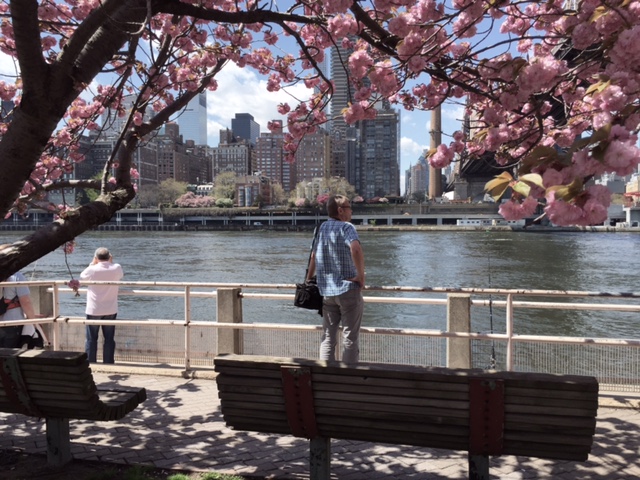
Finally, this weekend New York ran about 200 “Jane’s Walks,” named for Jane Jacobs, the renowned urban planner who wrote The Death and Life of Great American Cities and fought Robert Moses on many issues. JaneJacobsjpg My thanks to Jane for her foresight and to the Rangers of the Franklin Delano Roosevelt Four Freedoms Park on Roosevelt Island which I’d never been to before.  (The shop honors Fala, FDR’s beloved Scottie.) FalaThe Park, spare and elegant with winds whipping off the East river on both sides, is a tribute to FDR and the last work of the iconic architect, Louis I. Kahn.  On the island, the cherry trees were in full bloom, a treat for everyone including  the many Japanese visitors enjoying traditional picnics.

Cherry Blossoms on Roosevelt Island Facing Manhattan

Cherry Blossoms on Roosevelt Island Facing Manhattan

For an impromptu dessert, try Cherry-Pistachio Chocolate Bark. No cooking necessary. If you don’t have dried cherries or pistachios on hand, substitute any other dried fruit and nut combo.

 Cherry Pistachio Chocolate Bark

cherry-pistachio-chocolate-bark-hl-1940808-x

2 (3-ounce) chocolate bars (I’d go for the darkest bars, best quality you can buy)
3/4 cup unsalted shelled pistachios
1/2 cup chopped dried cherries
Unsalted shelled pistachios and dried cherry bits
Chop chocolate bars; place in a glass bowl. Microwave on high for 1-minute increments, stirring with a spatula in between, until the chocolate is completely smooth. Stir in 3/4 cup unsalted shelled pistachios and 1/2 cup chopped dried cherries. Spread mixture onto a parchment paper–lined baking sheet, sprinkle on a few more pistachios and cherry bits, and freeze for 1 hour or until firm. Break into pieces and serve.

Store what isn’t consumed in a tin container. Try not to sneak leftovers–but you will.

Posted in Uncategorized | Tagged , , , | 4 Comments

Not Art 105


An "ensemble" at the Barnes Collection

An “ensemble” at the Barnes Collection

We owe Dr. Albert Barnes several debts of gratitude. First, because he developed Argyrol, an antiseptic salve put into newborns’ eyes to prevent blindness. (Today’s version is Ilotycin and the same people who won’t vaccinate their kids rail against this practice.) Second, because Argyrol made Barnes ample money he was able to amass an extraordinary collection of Old Masters, Impressionist, post-Impressionist and modern paintings; Native American ceramics, jewelry and textiles, African masks, furniture, metalwork and a great deal more. Dr. Barnes displayed his collection in his personal, unorthodox style, grouping items to promote his approach to art education and appreciation.

Scouts Attached by Tiger Henri Rousseau

Scouts Attached by Tiger Henri Rousseau

I saw the Barnes years ago at its original home in Lower Merion, PA. Like many, I was horrified when Barnes’ will (or trust–lawyers, help me here) was broken (see the movie The Art of the Steal), but have to admit the new Barnes in Center City, Philadelphia, with state-of-the- art climate control and top class conservation in play is terrific.

And then there’s art speak. One example is when the audio guide explains that a Cezanne of apples is “linked” to the religious painting below “possibly to recall Adam and Eve.” Cezanneapples Well, maybe but I’m not convinced that M. Cezanne had the Garden of Eden in mind when he took up his brush to work on those apples. In another room, we’re told that a small table below the pictures “enlarges our connection with perspective.” I saw it as a small table holding small, pewter objects that had no connection at all with what was above.

Currently there’s an exhibit of two Cezanne works found during a cleaning of pictures Barnes owned. The works found on the reverse side of each  are now displayed so you can see both sides. This is a link to more about these pictures.

The Garden Restaurant at the Barnes is a charmer with widely spaced tables and smallish plates of delicious, stylish food. If you’ve never visited the Barnes (or even if you did in days gone by) go enjoy it in its new setting.

As Barnes’ wall groupings (which he called ensembles and constantly rearranged) items you might not ordinarily combine, here’s a recipe combining peanut butter and Sriracha Sriacha(a hot sauce that originated in Thailand). I’d serve this at lunch as a new take on a sandwich.

Peanut butter
Slice of toast
Sliced scallion
Fresh cilantro leaves
Sriracha
Fresh lime juice
Flaky sea salt (such as Maldon)

Spread peanut butter on a slice of toast. Top with sliced scallion, fresh cilantro leaves, and Sriracha. Finish with lime juice and flaky sea salt. And voila!peanut-butter-sriracha-toast-940x600

No cooking required. Somehow I think Champagne would be a great accompaniment but even if your tipple is a coke, raise your glass to Dr. Barnes.

Posted in Uncategorized | 4 Comments

In Jig Time

Scotland2About a month ago I found myself chatting with a man in a kilt. Other men present were wearing trousers so of course I asked how come. Long story short, I fell in with the Royal Scottish Dance Society which runs a program Thursday evenings at St. Bart’s.

Most of the time when I mention I’m learning Scottish country dancing someone says “Oh, the Highland Fling.” Nope. We dance reels, jigs and something called the Strathspey but these aren’t flings. Basic steps are easy; the geography isn’t but the whole thing is fun and a good workout for body and mind. I’ve got the step known as “set” figured out and Figure of Eight but often extend my left hand when it should be the right and so on. Fortunately, the people are lovely–kind, patient and they keep telling me that it takes a while to get the hang of it (an understatement.) There are quite a few British accents and some Scots, which is delightful. Here’s a link to a group dancing beautifully--wish I were this proficient!

Mid way through the evening, there’s a tea break. Literally. There’s also lemonade, shortbread and non-Scot items like Cheetos, sometimes pretzels. A water bottle is a good idea.

Most dancers, men and women, wear ghilliesghillies. Thus far I’m wearing flats; ballet slippers would also work. Several men wear kilts and knee socks which look great and add a touch of authenticity. If you’re in the area and want to give it a try, check out www.rscdsnewyork.org You can also see what’s about to explode in New York in terms of Tartan Week: www.tartanweek.com

I’ve never been to a Burns (as in Robert) night when haggis (sheep heart, liver and lungs with onion, oatmeal, suet and spices mixed with salt, traditionally cooked in a sheep stomach but now often in an artificial casing) is always served. I can hear the gags resound so instead this is a recipe for shortbread that’s easy and pretty much no fail.

Scottish Shortbreadshortbread
makes roughly 6 dozen
2 cups all-purpose flour
1 cup butter
1/2 cup superfine sugar
1/4 teaspoon salt
1/4 teaspoon baking powder
1 cup butter
1/2 cup fine sugar
1. Preheat oven to 325 degrees
2. Sift together the flour, salt and baking powder. In a large bowl, beat the butter and sugar together until light and fluffy. Add the sifted dry ingredients and mix to combine. Chill until dough is easy to handle, about 10 minutes.
3. On a lightly floured surface roll dough out to 1/4 inch thick. Cut into desired shapes (can be fingers, the easiest, or petticoat tails. If you opt for tails, Google the specifics). Place on ungreased baking sheets.
4. Bake at 325 degrees for 10 to 15 minutes.

It’s a wee bit of dessert.

Posted in Uncategorized | Tagged , , , | Comments Off on In Jig Time

Interesting Things

Blick_auf_Manhattan
New York is full of interesting things, some transitory, some permanent and others, well, semi-permanent.
I heard of The Museum of Interesting Things courtesy of an article in the New York Times on doings about the 19th century. The Museum was described as fun for “fans of period dress” which doesn’t really describe me although I love costume parties. The evening I went to had Suffragettes as a theme so I donned a white dress, green and violet shawl (Suffragette colors) and a big straw beach hat– very chic on the subway especially topped with my puffy coat.

Suffragettes in action

Suffragettes in action

The Museum is the brain child of Denny Daniel who brings events to schools, hospitals and other settings although the Museum seems to be gathering increased traction as an entity to visit. This particular “secret speakeasy” was held in the Soho Loft complete with cash bar, snacks including red velvet waffles and what looked like mac-and-cheese and displays of bloomers, other period clothes period books and pamphlets, an old gramophone and more.
Vintage music on original vinyl records played and an old film of Bessie Smith singing was shown. I’d thought the group would skew old but no–apparently Gen Y is also into the 19th century. Dressing up isn’t obligatory but makes it more fun. To find out more about the Museum or get on the mailing list, go here www.museumofinterestingthings.org

As part of the evening, Wildman Steve Brill, the park forager, spoke together with his daughter Violet, about medicinal and food finds in city parks. For his foraging and nature

Wildman Steve Brill

Wildman Steve Brill

calendar click here www.wildmanstevebrill

Both the speakeasy and the foraging tours are fun.

The recipe comes from Steve’s website. Dandelions are pretty easy to come by so take it away!

Dandelion Fried Rice– Wildman Steve Brill

index

serves 6-8
5 tbs. peanut oil
1 tbs. dark (toasted) sesame oil
2 cups common dandelion leaves, coarsely-chopped
2 small hot chili peppers, seeds and ribs removed, chopped, or 1/4 tsp. cayenne hot pepper, or to taste
4 large cloves of garlic, chopped
1 tbs. fresh ginger, chopped
5 scallions, chopped
1/2 cup texturized vegetable protein  ( per Steve, this comes from any health food store)
2 cups basmati brown rice or other brown rice
2-3/4 cups water (or 2-2/3 cups water if you’re using a rice cooker)
2 tbs. tamari soy sauce, or to taste
1 tsp. brown rice vinegar
Assemble all ingredients beforehand.
1. Stir-fry the dandelion greens in 2 tbs. of the peanut oil over high heat in a wok or frying pan, stirring constantly, 90 seconds.
2. Add the chili peppers, garlic, and ginger and continue stir-frying another 30 seconds. Remove from the wok and set aside.
3. Stir-fry the scallions and texturized vegetable protein in another 2 tbs. of the peanut oil 2 minutes, then remove from the wok and set aside.
4. Stir-fry the rice in the remaining peanut oil and the dark sesame oil 2 minutes.
5. Place all cooked ingredients and all remaining ingredients into a saucepan, bring to a boil over medium heat, reduce the heat to low, cover, and cook 40 minutes, or until all the water is absorbed (or cook in a rice cooker until done.)

Eat green, wear green, go green for the planet.


Posted in Uncategorized | Tagged , , , | Comments Off on Interesting Things

Myriad Museums

Oaxaca flowers

For a fairly small city, (just over 3.8 million) Oaxaca has a extraordinarily large number of museums. The Textile Museum is housed in an unimposing former colonial building; the interiors, (plural because there are several completely separate areas), are glorious with spare, beautifully thought-through exhibits. Textile MuseumNear the entrance was a video about making cochineal (in Spanish but we got the drift) followed by textiles dyed using the brilliant

crimson. Another area displayed wonderful photos of the dye -making process; in yet another gallery we admired a display of pen and ink work (and loved the space that is rentable for a gala party. Wish I could have one here!) A creative kids’ playground outdoors is set in front of a white wall with espaliered cactus plants; the path alongside has moss growing between herringboned bricks. Nearby is a cute coffee shop and what appeared to be a fancy restaurant (with no diners at the time we passed.) The gift shop is fabulous and I regret not buying a pillow case I saw but you know the one about hindsight.

A few days later we went to the tiny Museo Belber- Jimenez (hilarious to locate using our map because buildings tend to be “near” but not right at the designated spot–we left behind a lot of head scratchers probably due to my garbled Spanish.) Belber-Jimenez showcases the collection of Federico Jiménez, a jewelry maker originally from the village of Tutulepec, and his wife, Ellen Belber; it includes archeological and colonial jewelry, some fabulous decorated saddles and manikins dressed in gorgeous folk dresses.IMG_1302 There is also a small library where (depending on how good your Spanish is) you can do some basic research. Of course, there’s a gift shop.

The Museum of Contemporary Art, Oaxaca’s MOMA, is in the so-called House of Cortez (where Cortez never lived.) Upstairs was a display of carved pillars and objects in several rooms near galleries with wall drawings and a film explaining their origin as a codex (very old book) originally in the Vatican. This museum is light, airy and free. All these museums are in the central part of the city; walking around to reach them is part of the huge pleasure of being in the city. Stopping for a coffee en route is part of the deal.
Now to a real and supposedly easy mole. The daughter in law of the woman who runs the B&B we stayed at teaches cooking. This is her recipe:


mole

Mole Manchamanteles
8 pieces of chicken, cooked  (I’d probably use quartered breast pieces or maybe add in some thighs)
4 ancho chilies (dried chili)
1 kg tomato
1/2 onion
4 garlic cloves
3 allspice
3 cloves
1/2 teaspoon of oregano
1 cup of plantain slices
1 cup of pineapple slices
1 cup of apple cubes
Oil
Salt

Roast the chilies one by one over a gas flame using tongs.. Remove seeds and ribs and set aside (this is to make the end result not mind-blowingly hot.) Put chilies in 2 cups of water and simmer about 15 minutes until soft. Drain, saving the water.
In a pan at about 300, roast the tomatoes, onion and garlic cloves Strain the chilies and put in food blender with tomatoes, cloves, allspice and oregano. Put this mix into a pan with oil and cook for 20 minutes over a low heat. Add 1 cup of chicken broth and fruits. After 10 minutes season with salt and add the chicken pieces. Simmer for another 10 minutes. Serve.

Again, break out mezcal, tequila or Mexican beer. Salud!

Posted in Uncategorized | Tagged , , , | 1 Comment