

I thought I had a reasonably large vocabulary but this stumped me. It means “unshod” or “barefoot,” referring to Catholic religious orders whose members wear sandals instead of shoes as a sign of poverty, penance, and reform.
You could call Johnny Appleseed or Mahatma Gandhi discalceled. 
In search of another well-known unshod figure, in Mexico City I visited the Museo de El Carmen in the neighborhood of San Angel.
Built between 1615 and 1626, the convent was founded in June 1615 by the Discalced Carmelites. The Colonial Baroque building opened as a museum in 1938 and houses numerous pieces of religious art and a collection of twelve naturally mummified bodies of former benefactors, priests, 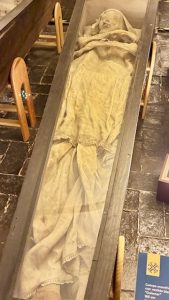 and wealthy parishioners interred in the crypt. The crypt floor is raised and the space dimly lit but you can walk among the mummies, some wrapped in now-darkened white fabric.
El Carmen has a lovely cloister with rose bushes at the sides and a blue-and-white tiled fountain in the center. Inside is a series of four lavabos, used for hand-washing usually before meals and/or worship, also made of tiles.
Carmelite nuns lived a cloistered, contemplative life dedicated to prayer, silence, and solitude, designed to foster a deep, intimate relationship with God. These followers of St. Teresa of Avila worked the large garden around the building providing members of the order with most of what they ate. On the second floor are former cells; number one was open but instead of a bed it now holds a desk with a skull and a few other ornaments on it. There are several chapels including one which has been gilded into blinding gold.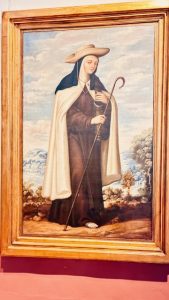
In the convent is a painting of St. Teresa in which she wears sandals, accepted by many as equal to no shoes.
Carmelites ate austere meals and no meat with exceptions for those who were sick. This recipe for fava bean soup comes from a contemporary Carmelite newsletter.
Carmelite Fava Bean Soup
- 3 cups fava beans (soaked and peeled)
- 1 ½ Tbsp. baking soda
- 1 ripe tomato, chopped
- 1 clove of garlic, chopped
- ½ small yellow onion, chopped
- Salt and ground black pepper, to taste
- 1 Tbsp. olive oil
- ½ tsp. ground cumin
- Put the fava beans in a pan and add enough water to cover the beans. Bring to a boil and add baking soda. Beans will froth and foam. Remove beans from pot and rinse with cold water; set aside.
- Combine tomato, garlic, onion salt and pepper in a blender or food processor and puree. (Pretty obvious this was written in modern times. Early on ingredients would have been mashed in a molcajete (mortar) and tejolote (pestle), traditionally hand-carved from volcanic basalt stone.)
- Heat oil in a 4-qt saucepan over medium-high heat. Add the tomato, garlic mixture and cook, stirring constantly, until it begins to thicken, about 5 minutes.
- Add the fava beans, 4 cups water, and cumin. Bring to a boil, and then simmer on low heat for at least 40 minutes. Salt and pepper to taste.
Note: If you are using dried shelled fava beans, reduce the amount of beans to 2 cups, add 4 cups of boiling water, and cook on medium-low until beans are tender, about 40 minutes, before adding baking soda.
I might skip this delight and 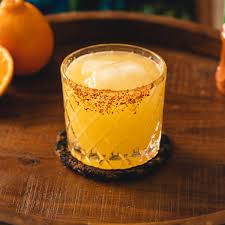 simply have a Margarita, Mezcalita, (Margarita’s cousin made with mezcal instead of tequila), or pulque, which is the fermented sap of the maguey or agave plant. The drink looks milky, has a low alcohol content and a slightly sweet taste. Or I might reflect on the friendly kindness of the many people I met in Mexico who cheerfully helped with directions and, with one exception, dealt patiently with my miserable Spanish.