Dingle Town


Gallarus Oratory near Dingle (look ma, no mortar!)

Gallarus Oratory near Dingle (look ma, no mortar!)

Dear Readers:

This is sort of a bonus post.  The editor of an article I wrote asked me to link to it via my blog. It’s about the town of Dingle that is on the famed–and obscenely gorgeous–Dingle Peninsula in southwestern Ireland.

Here’s the link:

http://www.cheaphotels.org/travelogues/2013/04/dingle-a-jewel-of-the-dingle-peninsula/

Hope you enjoy it.  No recipe so you can simply salivate for next time.


Posted in Uncategorized | Comments Off on Dingle Town

Sicily: Mt. Aetna and Perfect Arancini

Mt Aetna Mt. Aetna on a nice day

A few years ago visiting Sicily, we took a bus from Taormina south to Mt. Aetna. We left wearing tee shirts and shorts;  en route, we layered on sweatshirts, sweaters and long pants, forewarned about wintry temperatures on the mountain.  At the base of the volcano, in addition to tickets for the Funivia, a cable car, we were offered and accepted parkas–a good move.

Who put the fun in Funivia?

Who put the fun in Funivia?

The Funivia lifted us up and over mountains and dropped us where four-wheel vehicles were waiting to drive over a moonscape of craters and black, nubby lava.  Then we hiked about a half-mile in snow.  (I had on sneakers unlike some climbers with only clogs or sandals and cold feet.)

A few hundred feet from the summit, steam poured out of vents in the rocks, proof of Aetna’s internal activity. The heat on my hand held over a hole felt like water from a boiling kettle.

On the return Funivia ride I met a teen-aged boy and his mother going to rendezvous with her Sicilian family. Tom, the son, had a personal mission:  a search for the best arancini, the ubiquitous Sicilian snack made of rice, wrapped around a little meat with a few peas and crisply fried. (Arancini means little oranges but most I’ve eaten were far smaller.)

Tom confessed he sampled arancini every chance he got, sometimes eating at six or seven places a day. (Teen-aged boys don’t obsess about weight.) When I asked which ones he’d most enjoyed,  Tom leaned towards me and lowered his voice. This was top secret info.

“Are you going to Cefalu?”

“Absolutely.”

“Try the arancini they sell at the square in front of the cathedral. They’re fabulous, “he said. “My mother thinks that her mother’s version is the best in Sicily but I don’t want to start a family war.”

A week later, in the windy square in Cefalu, Cefalucathedralwe gorged on arancini. Tom was right; they were terrific, crisp and greaseless outside with a delicious filling.

To experience Sicilian food in New York, drop into Nica Trattoria on East 84th Street. A few caveats:  it’s not inexpensive and it’s cash-only. However, the welcome is exuberant, the food fabulous and everything is made to order. The chef/owner, delightful Giuseppe Nicolosi, Nico at Nica

gave me a recipe for fresh sardines a Beccafico (this translates as Warbler, as in the bird. Nothing birdlike about what he served.) However,  his handwritten recipe in Italian flummoxed even a fluent friend. Thus, we have a recipe for Arancini a la Siciliana (which our chef points out is strictly a peasant food.)


Arancini a la Siciliana

Arancini a la Siciliana

1 ½ cups long grain rice

¼ cup butter

2 T Parmesan cheese, freshly grated

Scant ½ cup ground beef (my guess is this is less than ½ pound)

Scant ½ cup white wine

2 T tomato paste

3 1/3 oz mozzarella, diced

2 eggs

½ cup flour

Vegetable oil for frying

Cook rice in boiling, salted water 15-18 minutes or until tender. Drain, put into a bowl and stir in half the butter and the Parmesan—then spread rice out on counter and let it cool.

Melt remaining butter in large pan, add beef and cook, stirring often, until meat is fully browned. Sprinkle in the wine and cook (about a minute) until it evaporates.

Stir in tomato paste, cover and cook over low heat for 15 minutes. Season with salt and remove from heat.

Shape cooled rice into little balls (roughly golf ball size) and hollow out the centers. Fill with a little meat sauce, 1-2 cubes of mozzarella and seal with more rice.

In shallow dish beat eggs with a pinch of salt . Put flour in another shallow dish and dip arancini first into beaten eggs, then into flour. Shake off any excess. Heat oil in a large pot and test –it’s hot enough when a cube of bread browns in thirty seconds. Fry arancini in oil until golden brown all over. Drain on paper towels and serve.

Full disclosure: I haven’t made these due to fear of frying. I do order them in restaurants!

,


Posted in Uncategorized | Tagged , , | 2 Comments

Not Wearing the Green But Baking the Bread

The day before the big green day, I went to the exhibition W W II in NYC at the brilliantly- renovated New York Historical Society.  Thanks to a friend’s generosity, I was part of a Barnard College Club group so I benefited  from a particularly knowledgeable, fun and funny docent.  We toured the exhibit, learning that Maidenform Bras almost didn’t exist during wartime because the War Production Board tried rationing materials until the outcry grew too great.

No lace, no style but a WWII Maidenform bra.

Part of the cyclotron that was used in the Manhattan Project is on view, looking ancient and in need of a polish. Visitors at this exhibit see and hear and see a host of artifacts ranging from a Philco radio broadcasting Edward R. Murrow to ship silhouettes in the New York Harbor to a fascinating film by a wartime cameraman who not only shot images of D-Day but also memorialized his visits to Picasso in Paris. It’s a great exhibit and well worth the time.

As part of the NYHS’s new look, it has a delightful new restaurant, Storico, serving lunch, brunch, “later afternoon,” (I interpret this as teatime), and dinner. My bresaola (air dried beef) panini with arugula and horseradish was served on wonderful, chewy bread;

another woman at my table said her eggs with pancetta and tomato sauce with more of that bread, toasted, was also terrific. Prices are reasonable and the setting, with  many different china patterns displayed in sleek, white cabinets set high into the walls and windows overlooking Central Park West, is lovely.

During lunch it began to snow. That, combined with the famed parade, snarled traffic but it’s all part of St. Patrick’s Day in the Big Apple.

The next day, actual St. P Day, I baked Irish Soda Bread Buns, inspired by a recipe from The New York Times. My parents had an Irish housekeeper who often made soda bread. I used to sneak into the kitchen and slice off a hunk –this recipe brought a lot of memories back. And, it’s easy. Herewith:

My Irish Soda Bread Buns

Soda Bread Buns (Melissa Clark, New York Times)

3 tablespoons unsalted butter, chilled and cubed, more for greasing pan

1 ¼ cups all-purpose flour  (more as needed to flour surface)

¾ cup whole wheat flour

¼ cup grams sugar

1 ½ tsp baking powder

1 tsp salt

¾  tsp baking soda

2/3 cup buttermilk, more for brushing (No buttermilk? Google proportions of vinegar put into regular milk—works just fine.)

1 large egg

2/3 cups dried currants (I used a little over ½ cup)

1 ½ tsp. caraway seeds

1. Heat oven to 375 degrees. Lightly grease a large rimmed baking sheet. (I used butter)

2. In a large bowl, whisk together flours, sugar, baking powder, salt and baking soda. Using a pastry cutter or your fingers,  work in butter until mixture forms coarse crumbs. In a small bowl, whisk together buttermilk and egg. Stir wet mixture into dry one until they just form a moist dough.  With your hands, mix in currants and caraway seeds .

3. Turn dough out onto a lightly floured surface. Shape into a 7-inch round about 1-inch thick. Cut into 8 wedges. I Ieft mine wedge shaped so they look more like scones. Melissa Clark does it this way: Using lightly floured hands, roll each wedge into a ball and transfer to the prepared baking sheet.

Using kitchen shears, snip a small “x” into the top of each bun. (You can also use a knife—I did.) Brush tops with a little buttermilk, and dust lightly with flour.

4. Transfer baking sheet to oven. Bake until buns are golden brown and firm, 20 to 25 minutes. Cool 10 minutes before serving.

Mine were done in 20 minutes. The crosses sort of disappeared but served with butter they make a great snack or breakfast. Slainte, “slan-cha”) as the Irish say.


Posted in Uncategorized | Tagged , , | 1 Comment

Brit Bonanza

Having reached the end of Season Three of Downton Abbey, I’ve been mesmerized by Parade’s End, another series about Brits in the dying days of the Edwardian period.  As the NY Times said, PE tells of a bad marriage set in the midst of a rotting civilization and stars Benedict Cumberbach, a convincing, understated actor.  No one in Europe other than Cumberbach’s character thinks war is about to explode.  Parade’s End isn’t as easy to deal with as Downton but it’s deeper and very revealing. Not as many gorgeous gowns but more complex camera work,  worth every minute.

For years, I have been a pretty rabid Anglophile although  I did not get up in the middle of the night to watch Dianna and Charles wed, nor did I hang onto every detail of William and Kate’s nuptials but I know a lot more about these people than I do about American starlets and stars.  Furthermore, I have a grudging admiration for the Queen , (always called the “Q” in our house),

not because she’s had the misfortune to have all her children turn out incredibly badly nor because the institution she heads is sort of a joke. I commend her because she sucks it up and soldiers on. Sure, I hate her awful hats and handbags but they suit her as they—like their wearer—are anachronistic. I once wrote an article about a desire to be the Q because it would free me of having to tote briefcase, large bag and purse to work on the subway each day, as well as being the way to escape from carrying money, a MetroCard

and all the other detritus that has always confused my purse. Bad idea; in retrospect, I’d much rather be me. The idea of having my life scrutinized by others horrifies me and, if you’re a Royal, you live in a glass house.

In keeping with things British, here is a recipe for sticky toffee pudding. I’ve had it before, (initially in Taormina, hardly a British outpost) but this version was brought by good friends as the conclusion to a simple but fabulous meal when we were last in Vermont. Both the husband and wife of the dinner team are excellent cooks; this offering was from the husband, a kind, sensitive guy who also bakes fabulous pies.  It’s not at all hard to make and feeds a lot of people.

Herewith:

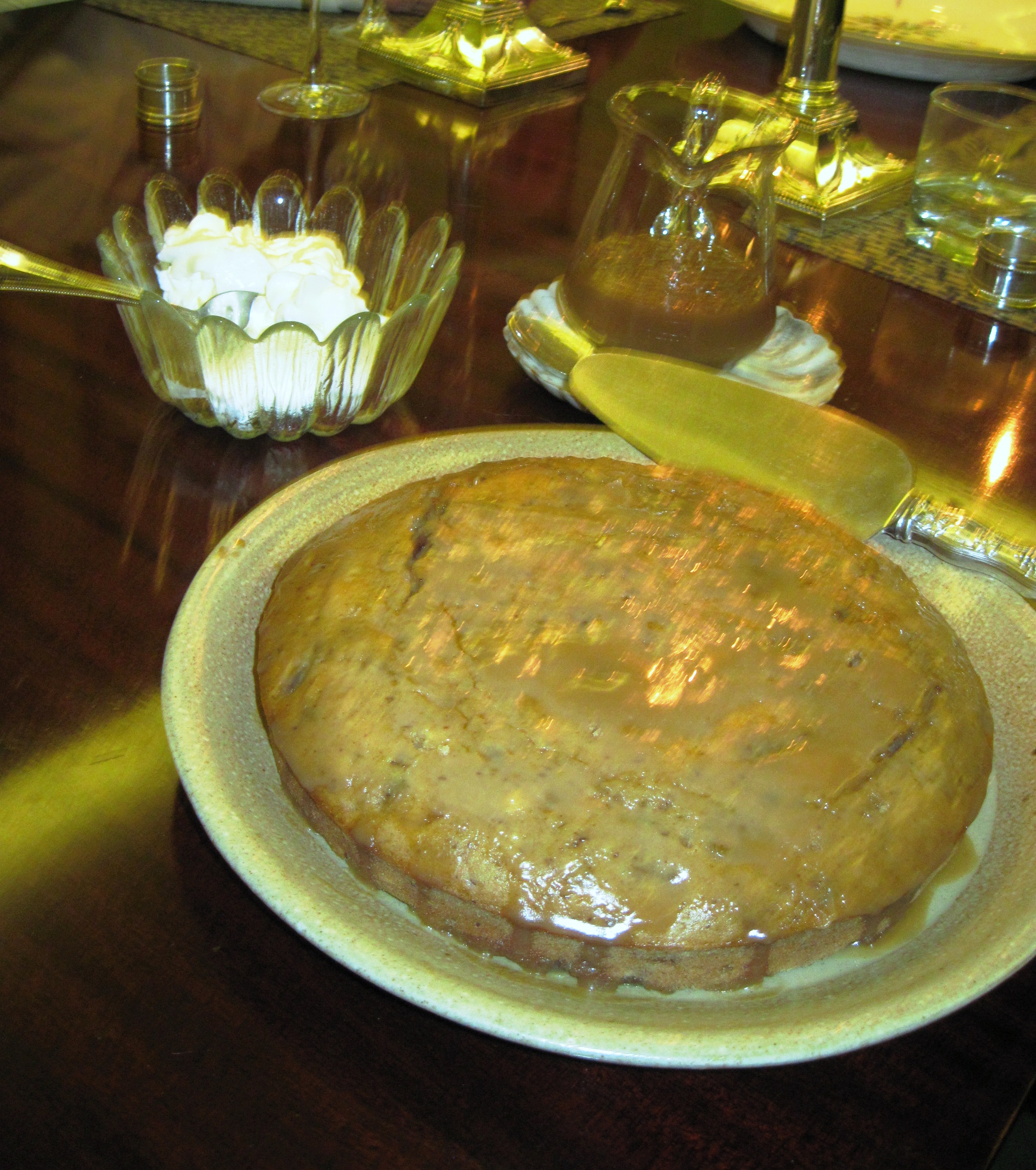
Sticky Toffee Pudding from Oprah via Jim Carter 
Sticky Toffee Pudding, Toffee Sauce and Whipped Cream

8 servings

1 cup boiling water

1 container (10 ounces) pitted dates

1 teaspoon baking soda

1 1/2 cups all-purpose flour

1 teaspoon baking powder

Pinch of salt

1 stick (8 tablespoons) butter at room temperature

5 tablespoons sugar

2 large eggs

1 teaspoon vanilla extract

1/2 pint heavy cream

1 cup light brown sugar

1/2 stick (4 tablespoons) butter

Whipped cream for topping (optional)

To make pudding: Preheat oven to 350°. Butter a high-sided 9-inch round baking pan; line bottom with waxed paper. In a medium bowl, pour water over dates; stir in baking soda, and let stand until dates soften, about 5 minutes. In another medium bowl, combine flour, baking powder, and salt; set aside.

In the bowl of an electric mixer, cream butter and sugar together until fluffy. Beat in eggs, one at a time, until almost smooth. With mixer on low, beat in flour mixture until just combined; add date mixture and vanilla until blended.

Transfer batter to prepared pan. Bake until top feels firm, 30 to 33 minutes. (mine was done in under 30 minutes.)

While pudding bakes, make toffee sauce: In a medium saucepan, bring heavy cream and light brown sugar to a boil, stirring occasionally. Add butter, and boil 3 minutes.

Remove pudding from oven; let stand 5 minutes. Place waxed paper over top of pudding, and unmold by inverting pudding onto a plate; invert again onto a serving plate, top side up. Using a fork, poke holes in surface of pudding so toffee sauce will seep in evenly. Spoon 6 Tablespoons sauce, one at a time, over top. Serve remaining sauce alongside warm pudding, with a bowl of whipped cream, if desired.

Note: I made it two days ahead and kept in, covered with foil raised by toothpicks in fridge. I also made sauce and kept it. Took pudding out about an hour before serving and warmed sauce in microwave.

Second note: This is my 100th post! Perhaps a drumroll is in order?


Posted in Uncategorized | Tagged , , , | 6 Comments

Don’t Play With Your Food

Maybe once in a great while mother doesn’t always know best. For Valentine’s Day,  we went to an entertainment that was, literally, “playing with food.”  Food Acts is  a series of short stories, quotations, and observations by famous people all involving food on NYC’s Little Theater Row.

We were greeted by two women wearing toques and aprons who presented us each with a Menu, aka, the program. 


Inside, food-related music filled the air, mostly oldies of the Animal Crackers in My Soup, If I Knew You Were Coming I’d Have Baked a Cake and Rum and Coca Cola variety. Eight actors got up as chefs spoke or enacted bits ranging from Dorothy Parker to Homer to Anthony Bourdain, some funny, some slightly icky (one about hog slaughter and another about rat cookery in restaurants in China.) Overall, the entertainment could have been a little shorter and had more musical numbers but we enjoyed it.

Then to Vermont where we were joined by some kids and grandkids. Over the weekend went a Fireman’s Breakfast (brunch for us) in West Pawlet to eat pancakes plain and/or with cranberries, blueberries or chocolate chips, waffles, bacon, sausage, scrambled eggs and home fries with juice and coffee. (Oh yes, someone offered us a piece of birthday cake and there were chocolate-covered cookies on the way out.)

At $7 an adult pop, the price was right and the atmosphere straight out of Norman Rockwell. In the afternoon, some of went skating and others to a Clawhammer banjo and fiddle concert featuring John Specker in a artesan’s gallery in Londonderry.


John Specker playing Clawhammer Banjo

(follow link to hear him on banjo– if it works) http://youtu.be/-V-9rE005a4http

In keeping with the high cholesterol theme of the day, for dinner that night we had fried chicken. Years ago, my family was looked after by Margaret Pruden who was our housekeeper-cum-babysitter. She also made the best fried chicken in the world. This isn’t exactly Margaret’s recipe but as close as I can come as she never revealed her secret.

Fried Chicken (slightly tweaked from Martha Stewart)

2 cups buttermilk (which you can make by adding 2 Tbls. white vinegar to just under two cups milk and letting it sit for five minutes.)

Kosher salt

3 teaspoons cayenne pepper

2 whole chickens (2 1/2 to 3 pounds each), each cut into 10 serving pieces (wings, thighs, drumsticks, and 4 breast pieces)

3 cups all-purpose flour

4 cups vegetable oil

In each of two 1-gallon resealable plastic bags, combine 1 cup buttermilk, 1/2 tablespoon salt, 1/2 teaspoon cayenne, and half the chicken pieces. Shake to coat, refrigerate up to 2 days. (Or an hour or so.)

In a large shallow bowl, whisk flour with 2 tablespoons salt and remaining 2 teaspoons cayenne. Dredge chicken pieces one at a time in mixture, shaking off excess.

In a 12-inch cast-iron skillet heat oil to until a pinch of flour sizzles when dropped into it. This means oil is roughly 350 degrees.

Carefully add 1/2 of the chicken. Cook 10 minutes: turn chicken with tongs. Cook until golden brown and juices run clear, about 10 minutes more. Transfer to a paper towel draped rack to drain.

Return oil temperature to 350 degrees. Repeat with remaining chicken. Season with more salt if you wish. Serve, whistling Dixie.


Posted in Uncategorized | 6 Comments

I’m Not Called Little Buttercup

New York City Gilbert & Sullivan Players

My father and his brother were huge Gilbert and Sullivan fans and started me off young at performances at the Jan Hus House (still there.) I learned the music and was thrilled that my camp always put on a G &S operetta. Some years I was in the chorus; other summers I  had a part and once– oh rapture! — played Mabel in Pirates of Penzance.  I passed the G&S torch to my older daughter whose enthusiasm infected her daughter, my granddaughter. It didn’t hurt that her  school taught the  seventh grade I Am the Very Model of a Modern Major General. Last weekend that seventh grader and I saw  H.M.S. Pinafore at City Center, performed by the New York Gilbert & Sullivan Players. It was brilliant—possibly the best production I’ve ever seen and I’ve probably seen Pinafore fifty times, maybe more.  As a bonus, we were treated to a pre-show talk by the company’s director and a post-show backstage tour with cast members where we walked on the set and saw what the auditorium looks like from the stage.

Onstage at City Center


The pre-show talk was a revelation of G & S factoids. I knew that Victorian-era sailors were called “tars” because they picked up the substance from climbing the  ship’s riggings, smeared with tar  to keep the ropes from disintegrating in the sea air.  What I didn’t know was that the classic tar salute is with an open palm turned away to show their officer that they had washed their hands!  I also never understood that the last names of the sailors like Deadeye (as in Dick) and Rackstraw (as in Ralph—pronounced ‘Rafe’), are parts of a ship. Worse, the irony of naming a  navy ship after a dainty pinafore had missed me. One more:  the real-life model for Sir Joseph Porter, K.C.B. (Knight Commander of the Bath) who was made First Lord of the Admiralty, was a bookseller who had indeed stuck close to his desk and never gone to sea. Instead of being insulted by the song, he loved it and went about humming the tune.

                                             Sir William Schwenck Gilbert who had difficult, cold, parents was the librettist; Sir Arthur Sullivan, who never married but had serious relationships with many women, wrote the music. Both wrote prodigiously apart from each other but neither received the fame separately that was generated by their fourteen collaborations. If you’ve never seen Mike Leigh’s film, Topsy Turvey, about the G&S collaboration, do yourself a favor and rent it. I’m sure it’s not entirely historically accurate but it’s lots of fun even if you’re not an ardent Savoyard.

Sir Arthur Sullivan


In keeping with the Victorian nature of the above, here is a recipe for The Victorian Cucumber Sandwich—the perfect item to serve at high tea!


1 large cucumber, peeled
Salt
1 T. olive oil
1 tsp lemon juice

Scant tsp. sugar
Freshly ground white pepper

About 3 T creamed, unsalted butter

Thin sliced brown or white bread, crusts removed

Cut the cucumber as thin as you can with a mandolin if possible (watch those fingers!) Salt the slices lightly and let them drain in a colander weighted with a plate for about two hours, pressing from time to time to get rid of the juices.

Combine the sliced, drained cucumber with the oil, lemon juice, sugar and the fresh-ground pepper—no more salt. Spread thin slices of brown or white bread with creamed butter and, at the last minute, fill with the cucumbers. Serve immediately so the sandwiches don’t get soggy. Each sandwich should be no more than two bites. Victorian ladies were very delicate.  Hum Three Little Maids from School or another G&S favorite while you enjoy your tea.


Posted in Uncategorized | Tagged , , , , | 3 Comments

Round and Square

Central Park Arsenal (right at the entrance to the Zoo)

I have lived in New York my entire life and only recently found out about the Arsenal Gallery.  It’s in the old, brick building in front as you enter the Central Park Zoo, now devoid of large animals but still home to the seals, penguins and some other holdouts. The building itself, built between 1847 and 1851, predates the park and began life as a munitions storehouse. The “atrium” lobby has 1930s WPA murals of historic scenes of the 19th century including what look like Civil War soldiers in formation. Each holiday season the gallery mounts a wreath exhibit (that could use better publicity.)  This year’s show had forty-one entries, many made of unusual materials ranging from old bicycle tires to Chinese food containers.

Wreath made of Chinese food containers

One is made of whole almond shells collected from a family farm in Greece. Another is the work of a native American, judging by his name, that includes wind charms, feathers and shells described as “wampum.”

Recycling nut shells


Walking back uptown through Central Park, most people weren’t speaking English.  We New Yorkers should be very glad tourists visit, stay in our hotels, go to our theaters and museums, eat in our restaurants and do their bit for the city’s economy.


The American Museum of Natural History currently has a show called Our Global Kitchen: Food, Nature, Culture, that’s interesting but could be more so. Obviously works of art need dim lighting to preserve them but why does a display of modern artifacts or reproductions need to be so dark and why have display notes in white print against a dark ground making them hard to read? The items to smell in the test kitchen are in bins that require Paul Bunyan to open. (Cranky visitor here, sorry.)

The part of the exhibit I most enjoyed were vignettes showcasing food from the eras of famous people. Jane Austin presence is recalled via ice cream, served in a fancy mold to the gentry she wrote about.

Austin ice cream mold

An ancient Roman’s “h’ors doeuvres” are on view.  Elsewhere, there are (replicated) square watermelons as grown in Japan inside special glass containers that set their shape. A recreated Aztec marketplace is full of model foods including crickets for nibbling but, having been to real markets in modern Peru, it’s hard to equate shiny, clean-appearing foodstuffs to the real thing that is far more chaotic and a lot dirtier. I did learn that potatoes were poisonous until peoples in the Andes transformed them into edible crops some 7,000 to 10,000 years ago.

Recreated spotless Aztec marketplace


I adore potatoes so in this spirit, here is a recipe for a potato side dish that’s delicious and a cinch to make.


Oven “Fried” Potatoes

 Serves 4

4 russet (baking) potatoes, peeled and sliced diagonally 1/8 inch thick (technically, use a mandolin to slice. You can also do the job with a sharp knife.)

1/2 stick (1/4 cup) of butter, melted

Coarse salt to taste

Pat the potatoes dry between paper towels and arrange them in one layer in 2 buttered cookie sheets; if you have a non-stick cooking spray, this works fine for greasing the pans. Brush the potatoes with the butter, bake them in a preheated 500°F oven for 15 to 20 minutes, or until the edges are golden brown. Sprinkle them with the salt.

P.S.  NYC Foodie alert: if you like tapas as in the real deal, take yourself to Txilkito (“chekeeto”) in Chelsea at 240 Ninth Avenue. They take reservations for parties of three or more and the food is fabulous.  We had something resembling a Basque “cookie” with a slightly spicy mushroom filling inside two pieces of grilled bread (four in a serving); ultra thin-sliced pork plated with a puree of fava beans and a hot dish of white beans with mussels. And more. All divine.

Posted in Uncategorized | Tagged , , , , | Comments Off on Round and Square

‘Twas the Afternoon Before…

Not quite Rudolph

As we have done for the last three years on Christmas Eve afternoon, some members of my family and I went to see the gingerbread creations at NYCs Parker Meriden hotel. My older daughter and her daughter wore their reindeer antlers the entire time including on the bus downtown and back on the “everybody here is from out of town and who cares anyway? theory.  They got a lot of smiles and approving nods.

At the hotel, only six creations were on display, most terrific. My personal fave was the Sphinx with crumbling nose (as in the real one)


with a chariot lying in the sand nearby, a little baker’s creative license.  Mexico’s Chichen  Itzh, one of the “new” seven wonders of the world,  was also brilliantly conceived although it didn’t make the climb up to the top even remotely as terrifying as my recollection of doing it years ago.The Lincoln Memorial, in white fondant with blue earmuffs and mittens, was fabulous. 


The windows at Bergdorf Goodman were fun but not to be compared with those of 2011 in which each featured a different material like paper or stone– far more creative than this year’s tribute to the Jazz Age.


Before our outing we had a wonderful lunch of Chinese Frittata, recipe below. Lasagna and salad dealt with Christmas Eve; Christmas Day was filled with family consuming  oceans of Prosecco, gravlax and sauce with black bread, goat cheese, flatbread, edamame, sliced flank steak marinated in teriyaki, babaganosh, pita chips and pizza squares followed by bread pudding with whiskey sauce and ice cream for the younger set (the ice cream, not the whiskey sauce.)

Last week also marked the memorial for Isiah Sheffer, founder of Symphony Space and creator of many programs including Selected Shorts.

Isiah Sheffer

The event, by ticket only, was terrific and very in keeping with Isaiah’s personality—funny and erudite.  There were clips of Isaiah singing a song about arugula and another about his dislike of  NY Times writer Paul Krugman, talks by his wife, daughter and numerous friends/business compatriots and colleagues. After two hours at seven PM, I tore myself away as the end was not in sight and I wanted to get home.


Now comes the doldrums period between Christmas and New Year’s. I feel a bit cooked out but will undoubtedly find that feeling has passed before long and embark on a new cycle.

Chinese Frittata

Serves 5-6 ( to serve more increase number of eggs, milk, butter and amount of leftovers)

8 eggs

Milk (about 1/4 cup)

3 generous T butter

Leftover Chinese food –don’t be fussy, just use anything you have be it vegetable or animal, the more the better, including rice.  Cut meat and veggies into thin strips.

Shredded Parmesan

Beat eggs with milk. Add salt and pepper unless your leftovers have a lot of soy in them making the end result sufficiently salty.

Use a large pan that can go into your oven. Heat oven to 350 and put the pan into  the oven with the butter in it. Pay attention—you want the butter to melt but not brown. When melted, pour in half the egg mixture and return to oven. After about eight minutes, add the Chinese leftovers and Parmesan. A minute later, pour the remaining egg mixture over the top. Bake another ten minutes or so.

To serve, cut into wedges. Serve with a hearty green salad and bread if you wish.  Bundle up and enjoy a pre-Christmas walk.  Happy 2013 to all!


.

Posted in Uncategorized | Tagged , , , , , , | 2 Comments

Emerald Green–Mostly

The Burren

When visitors back from Ireland say “it’s so incredibly green,” they are not factoring in the Burren, a large area in northwest County Claire. The Burren is dark and brownish, resembling a lunar landscape because it’s mostly limestone with isolated rocks called clints, criss-crossed by cracks or ‘glints.’ There is some green as numerous Arctic, Mediterranean and alpine plants grow, often next to one another.  An esker, (long ridge of stratified sand and gravel), snakes through the Burren and the whole area has a weird, unworldly quality.


Not exactly comfy…

Poulnabrone Dolmen is technically a portal tomb although the folk story as told by Dave, our Wolfhound leader,  depicting it as the “bed” of mythological King Dermott and his lady love, Grania, is a more charming way to think about it. As a bed, it’s not quite a Tempurpedic but the Irish are nothing if not fanciful.


En route to the Burren, we passed a sign for Lisdoonvarna, a town famous for its annual matchmaking festival in September (and the title of a Christy Moore song). Apparently many of what are referred to as “bachelor farmers,” i.e., not to be confused with gorgeous Irish men of the Colin Farrell  and Gabriel Byrne variety, attend this event during which the town goes into singles-fueled madness.

The Cliffs of Moher are one of the top tourist attractions in Ireland and, as such, typically mobbed. Because we arrived there late on a chilly day, while not alone, we didn’t have throngs of people to contend with. The cliffs, seven hundred feet high in some spots, are all about the view that stretches way into the horizon with the ocean churning below.

Cliffs of Moher (photo: Christopher Crim)


Although a fierce wind whipped about and it was pretty cold, the truly spectacular view was mesmerizing (as was the thought of a pub visit later on.)

High Celtic Cross, Clonmacnoise Abbey (photo: Christopher Crim)


Our last major stop before returning to Dublin was at the monastery of Clonmacnoise on the River Shannon where several ancient High Celtic crosses are on display, many moved indoors to shield them from further erosion by the wind and rain.


No recounting of the Irish countryside would be complete with reference to sheep, grazing on every hillside, in pastures next to ancient stone structures and, inevitably in the road. Waiting for sheep to get out of the way is a commonplace  event. The sheep seem very good-natured and no one rushes them.


In honor of the sheep, this is my go-to recipe for lamb stew.


LAMB STEW


Feeds 4 depending on how hearty the appetites are.

3 pounds lamb for stew (meaning it has bones in it)

2 Tbls. olive oil

2 cups beef broth

2 cups potatoes peeled and cut into pieces about the size of a quarter

6 carrots, cleaned and cut into pieces roughly the size of the potatoes

18 small white onions, peeled

2 Tbls tomato paste

3-4 turnips, peeled and cut into pieces about the same size as potato pieces

3-4 parsnips, cut like other veggies

2 cups frozen peas

2 cups frozen string beans.  (Note: if you prefer to use fresh, fine.  Just allow a little longer to cook them into the stew.)

Brown the meat in the oil. Add the broth and scrape up any brown bits in pot. Add tomato paste.  Put lid on pot and cook at low simmer for about one hour.  Add potatoes, carrots, turnips, parsnips, onions. Cook 1 hour more or until veggies are tender.  Skim any fat off top  Add the peas and beans (no need to defrost) stir in and simmer until they are tender.

Served with cheese, bread and salad, it’s dinner.

Posted in Uncategorized | Tagged , , , | 1 Comment

Of Trotters, Snugs and Hurling

Continuing the Irish saga, we made a stop at Cork’s English Market, put on the ‘must see’ list when Queen Elizabeth  visited last year. 


Although I loved these pigs’ trotters I won’t be providing a recipe for them (and hear those sighs of relief!) Later, a group of us slogged uphill through six muddy miles along The Windy Gap in the National Park of Killarney, admiring the very old oak trees and stone walls entirely covered with moss.


Horseback riding on Derrynane Strand was one the highlights of the Ring of Kerry—the beach is magnificent and when we visited, totally empty.


From Jessie’ back (my horse) there was a first class view of the former home of Daniel O’Connell, elected the first Catholic Mayor of Dublin in 1841. This very “flash” property, as the Irish would call it, is now a museum.

We spent a couple of nights in Portmagee, a picturesque fishing village that is the jumping off place for visiting  Skellig Michael, an ancient monastery literally hewn out of the rock by monks and occupied until the 12th or 13thcentury. Reaching the top involves an hour-long boat ride and then climbing 600+ slippery stairs—since I was a tad beat after the previous day’s hike and horseback adventures, I declined and opted for a tamer outing at an exhibit about Skellig Michael and visit to an old slate mine followed by a long bike ride, carefully staying on the left on narrow, twisting roads with the Atlantic on my right and palm trees dotting the road thanks to the temperate climate.

“Beehive’ monks’ cells on Skellig Michael


On another beach, we played (well, attempted) two Irish national games, hurling and Gaelic football. My talent for both is non-existent but loved my stint as goal tender with the assistance of a very enthusiastic Jack Russell Terrier. (She insisted on chewing the ball, not in accordance with the rules. The Irish take their sport seriously.)

The sidewalk in front of Dick Mack’s pub in Dingle is marked with stars from celebrities who have visited, sort of the Dingle answer to the Hollywood Walk of Fame. The pub is quintessentially Irish, perfumed by beer and boasting two snugs, little “rooms” formerly reserved for women with separate openings both to the bar and the front door so that ladies wouldn’t have to mingle with men, a relic of bygone times. We met several quintessentially Irish bar flies–older men minus most of their teeth who spend their days at the bar but still have a certain charm and love to talk.  After Dick Mack’s we moved to Foxy John’s, a pub that is also a hardware store, and then to yet another pub for some  (spontaneous) Irish music.

As many of you are likely dealing with leftover turkey, this recipe for colcannon would make a great accompaniment. It’s not exactly a Weight Watchers recipe but a nice after dinner hike would help dispel the calories. And, you can always tell yourself the greens are healthy.

Colcannon

Colcannon

Serves 4

4 russet potatoes (2 to 2 1/2 pounds), peeled and cut into large chunks

Salt

5-6 Tbsp unsalted butter (with more butter for serving)

3 lightly packed cups of chopped kale, cabbage, chard, or other leafy green

3 green onions (including the green onion greens), minced (about 1/2 cup)

1 cup milk or cream (your call—I opt for milk but it’s richer with cream)

Put potatoes in a medium pot and cover with cold water by at least an inch. Add 2 tablespoons of salt, and bring to a boil. Boil until potatoes are fork tender, 15 to 20 minutes and drain.

Return the pot over medium-high heat. Melt butter in pot and add greens. Cook greens 3-4 minutes, or until they are wilted and have given off some of their liquid. Add the green onions and cook 1 minute more.

Pour in milk or cream, mix well, and add potatoes. Reduce the heat to medium. Use a fork or potato masher and mash the potatoes, mixing them up with the greens. Add salt to taste and serve hot, with a knob of butter in the center.


Posted in Uncategorized | Tagged , , | 1 Comment