
Swing Time


Damrosh Park at Lincoln Center ready for MNS

Damrosh Park at Lincoln Center ready for MNS

Midsummer Night Swing at Lincoln Center is celebrating its 25th season. This iconic dance party attracts all ages and ethnicities as well as neighborhood people with their  dogs enjoying their evening stroll. I went with an out-of- town friend, partly because I love to dance and also to show said friend what a nice group New Yorkers can be. A ten on both counts.

Bags of all kinds are strictly verboten so these get checked. The staff at the checkout area  must pass incredibly tight background investigations as there has never been a complaint. To get onto the dance floor, you need a ticket and your wrist is stamped so you can  move on and off  the floor at will. (Note to the financially prudent: if you’re willing to forgo the lesson, you can hear the music and even dance pretty close to the floor.)

Midsummer Night Swing in progress

Midsummer Night Swing in progress

The evening always begins with a dance lesson; in our case, the instructor was a perky woman who managed to be upbeat but not upchuck-inducing. She and a male partner garbed in sailoresque clothes, aided by  a large coterie of similarly dressed helpers, took us through their version of the Lindy (not named after Charles Lindberg but that’s another story kiddies.) The lesson groupies are lined up and ivided into “leaders” and “followers.” As there are–of course–more women than men– many leaders (including me) are female but it couldn’t matter less. You change partners often throughout the lesson, meeting delightful people at every step (although the guy in front of me had two left feet, both ending in Rosa Klebb-style shoes

Rosa K, aka Lotte Lenya and her famous footwear

Rosa K, aka Lotte Lenya,  and her famous footwear

with which he did a little damage to my ankles.) My friend reported dancing with New Yorkers who originally hailed from all over the globe and found every one of them a gem.


The band was The Hot Sardines–were I a tad younger, I’d describe them as “awesome.” It’s a cool swing band with a very good vocalist and a member who tap dances. Here’s a taste of the Sardines…(click and follow link)

https://www.youtube.com/watch?feature=player_embedded&v=JLhhlQzbRI0

Other evenings are devoted to salsa and other Latin beats, different big bands, the music of ABBA and other genres.

Alcohol is available but my sense is that consumption if pretty limited. We noted one sniffer dog with his handler but a more benign, drug- free atmosphere would be hard to come by. There are some very talented, clearly experienced, dancers to watch and sometimes a “performance.” If all that dancing works up an appetite, Hill Country BBQ sells various foods and there’s a gelato stand. People dance as couples (same or opposite sex) or solo and no one cares about anything but having a great evening bopping around in an unbeatable setting to fabulous music.

All that dancing works up a thirst. Cool off with:
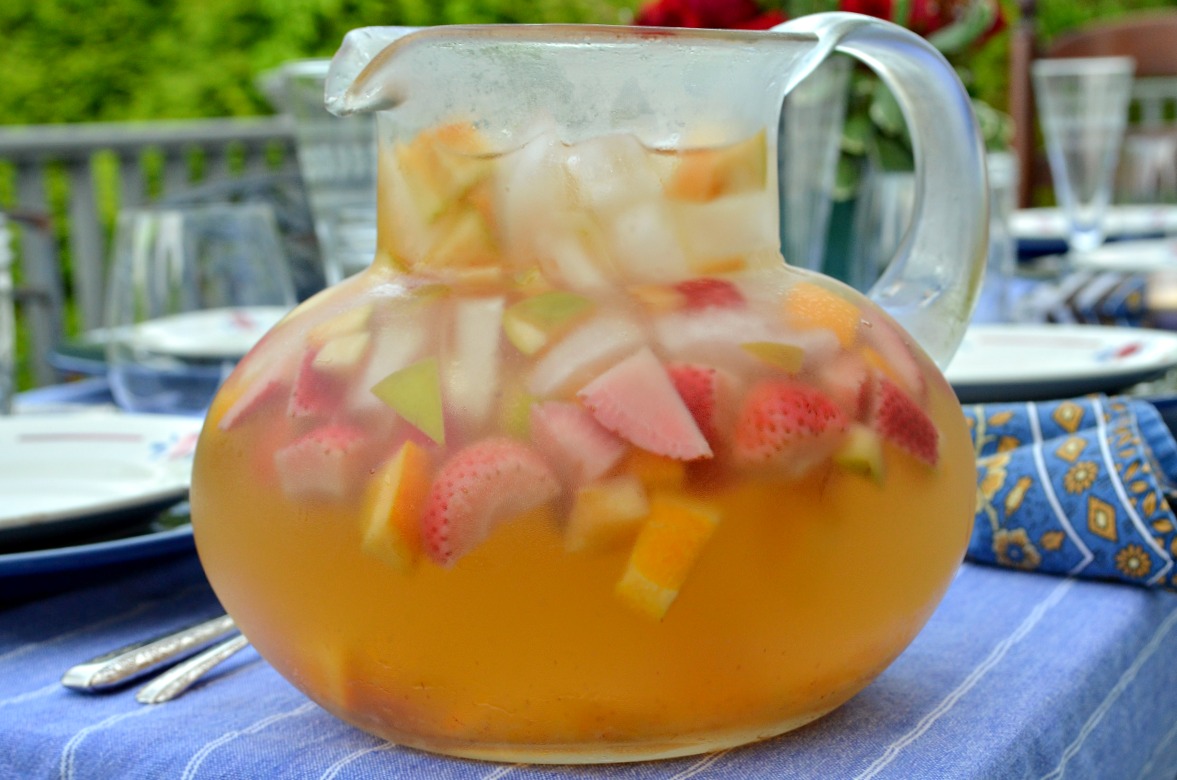
White-Sangria

White Sangria (Rachel Ray)
Yield 8 glasses    Difficulty: Takes about five minutes.

3 tablespoons sugar
3 shots Calvados or other apple liquor
1 lime, sliced
1 lemon, sliced
2 ripe peaches, cut into wedges
3 ripe green apples (as in Granny Smith) seeded and cut into wedges
1 bottle dry white wine
1 pint raspberries
Seltzer

Combine sugar, Calvados, lime, lemon, peaches and apples in a large pitcher. Cover with 1 bottle of wine and chill several hours. To serve, spoon fruits into glasses, adding a few fresh raspberries in each glass, pour wine over top of fruit. Top off each glass with a splash of seltzer.

Get out those dancing shoes!



Posted in Uncategorized | Tagged , , , | 3 Comments

All the World’s a Stage

Shakespeare.

It’s a gorgeous Sunday so the waiting line at the Delacorte Theater in Central Park is studded with people reading the Times or occupied with iPads or Kindles. This would be a great pick-up spot but we’re here for tickets, not romance. A very accomplished saxophone/bass duet plays golden oldies like It Don’t Mean a Thing and L-O-V-E first covered by Nat King Cole.Nat King c

I arrive at 10 AM. At 11 the food service window opens, offering “gourmet” hotdogs, faro salad (this is New York, after all), coffee, tea, fancy ice cream and more. A guy at the box office explains that the number of tickets released for each performance differs depending on how many seats are set aside for cast members, sponsors and the like. At 11:30 proof of ID (meaning age) is requested. After that, we are asked for our zip codes (hello marketing.)

Promptly at noon tickets are distributed and I score.
Walking home through the Park I come upon a group of people with cameras, (both iPhones and serious lenses) trained on a bird. One guy unplugs his earpieces long enough to explain that it’s a red-tailed hawk.

Not the one I took which is too vague

Fast forward to the performance of Much Ado About Nothing with Lily Rabe as Beatrice, Hamish Linklater as Benedick and Brian Stokes Mitchell as Don Pedro. The production is brilliant from start to finish with the minor exception of a piece of scenery that shakes too much when actors stand on top of it. Very clever lighting mimics a thunderstorm, the actors are great and even the amplification is done right, clear but not so loud as to feel like an assault.

Rabe and Linklater in Act I

Rabe and Linklater in Act I


One gripe: I wish audiences wouldn’t leap to their feet at the end of every performance because 1) if every theatrical endeavor is worthy of a standing ovation, how do you reward the truly terrific and 2) if people stand, you must also or you can’t see. Hiss, boo. It’s too nice an evening for my Inner Grinch.

Before the show many people picnic. Next time you do, bring this easy slaw that pairs well with anything.Slaw served here with tacos

Crunchy Slaw  (Martha Stewart)
1/3 cup light mayonnaise (I use regular)
3 tablespoons white-wine vinegar
3 tablespoons freshly squeezed lime juice, from about 2 limes
1 tablespoon sugar
Coarse salt and ground pepper
1 small green cabbage, about 2 pounds, halved, cored, and thinly sliced (Note: do NOT use red cabbage as it turns the slaw pink)
1 bunch radishes, ends trimmed, halved, and thinly sliced (about 1 1/2 cups)
In a large bowl, whisk together mayonnaise, vinegar, lime juice, and sugar; season generously with salt and pepper. Add cabbage and radishes; toss to coat. Cover and refrigerate, at least 1 hour and up to 1 day.

Serve with a hey nonny nonny.


Posted in Uncategorized | 2 Comments

Good Writer, Bad Interview

Edward St. Aubyn, cute and aloof

Edward St. Aubyn, cute and aloof


My feelings about the Patrick Melrose novels by Edward St. Aubyn are akin to what I imagine the rabbit feels like waiting for the fox to pounce. These five books are brilliant–painful but terrific, shot through with lancing humor. Since I’d also seen the piece on St. Aubyn in the New York Times, when I learned that St. Aubyn would read at Symphony Space and be interviewed by writer Francine Prose, I couldn’t wait to go.
Not so fast. Turns out the event was sold out but I was told that by arriving early, a ticket might turn up. California Chrome failed me

California Chrome, my vote for classy

California Chrome, my vote for classy

but Symphony Space did not; I scored a seat on the stage no less, at the side where I could see and hear but didn’t appear part of the gig.

St. Aubyn turned out to be a really terrible interview. His British dry humor and upper classness made many of his responses trail off as though he’d run out of breath. Some answers to Prose’s well-thought through questions amounted to little more than a flat “yes (or more often, “no.” Hats off to Prose for fighting the good fight.)

Francine Prose

Francine Prose

To be fair, excerpts St. Aubyn read from his new book, Lost for Words, were hilarious so even if I don’t grasp every inside- the- British- literary- word allusions, I will read it. (Note: this book is about an invented literary prize–no trauma, no pain.)

Of course books (by both authors) were for sale afterwards and could be autographed. But St. Aubyn put me off him (as a personality, not a literary figure) so much that I couldn’t bring myself to buy his book and certainly didn’t want to ask him to sign it.

Coincidentally, I’m reading This Is the Story of a Happy Marriage by Ann Pachett, a collection of articles she’s written that appeared previously (and not in a league with St. Aubyn’s work.) One piece deals with the horrors of the book tour. My sense is that ultra-reserved St. Aubyn is in the throes of these horrors. Too bad because I’d like to love both his work and his persona but can’t get over how hard he made both Prose and the audience, who were part of the Q- and -A, work.

I have some insight into book tours as during my long stint at a PR agency, I set them up. When giving interviews, authors answer the same questions over and over until they become mechanical but, as Pachett says, it’s better to be asked to tour than not. Selling is part of the job, and in today’s publishing world of tight money, little or nothing is done to help authors.

As a nod to St. Aubyn’s birthplace, this recipe is vaguely related to trifle, that aristo British dessert that is often a revolting mess of whipped cream. This one is easy, pretty and looks like you spent a long time making it. Not so.

summerpud

Summer Pudding

1 c. raspberries picked over
1 c. blackberries
1 c. blueberries
1 c/ strawberries hulled and quartered (note about berries: fresh are better but if one type is elusive, feel free to substitute frozen.)
1/4-1/2 c. sugar, depending on sweetness of berries
2 T Cassis
Grated zest of 1/2 lemon
8 slices white (Wonder or similar) bread.

In saucepan combine berries (reserving a few for garnish), sugar, lemon zest and Cassis. Bring to simmer. Cook until sugar has dissolved (about 4 minutes), stirring occasionally with wooden spoon, lightly crushing berries to release juices. Remove from heat and transfer to chilled bowl.
Line 3-cup bowl with plastic wrap, leaving a 2” overlap. Cut circle from one slice of bread to fit bottom of bowl. Cut bread slices to line sides of bowl making sure there are no gaps. Press lightly into place.
Spoon berries and juice into bread-lined bowl, cover top with remaining slices cut to fit. Fold plastic wrap over bread and top with small flat plate that fits snugly into bowl. Place a weight on plate, refrigerate overnight.
Unfold plastic wrap from top of pudding and carefully invert bowl onto serving platter. Remove wrapping and garnish pudding with reserved berries.
Serve with crème fraiche, ice cream or whatever.

Whatever would be a typical St. A response if he bothered to respond to your question: “which would you prefer?”  Do not serve with heroin or alcohol, both commodities this author has had plenty of experience with.


Posted in Uncategorized | Tagged , , , | 5 Comments

Risen From the Ashes

St JohnChinese artist Xu Bing used what is referred to as “detritus” but many of us would label “trash” to create two giant Phoenix (yes, that’s the plural) that currently hang in New York’s St. John the Divine in Morningside Heights. Winging over the nave, Feng, the male, and Huang, the female, are gigantic, made under Xu’s supervision by migrant workers using demolition materials and worker’s tools found in Beijing.

In Greek mythology, the phoenix is a long-lived bird that cyclically attains new life by rising from the ashes of its predecessor. Obviously,  no one has any idea what the bird looked like.

Feng and Huang were previously on exhibition at MASS MOCA in North Adams, MA, one of my favorite museums. Since they weigh a stunning twelve tons (one is 90; the other 100 feet long), transporting them to New York took eleven flatbed trucks. To get the birds inside, the Cathedral had to remove its massive front doors. You have to walk under and around them to take them in fully and pictures don’t do them justice.Phoenix

The day I visited, a bishop was being ordained so there were clergy from all parts of the world, many in bright-colored vestments, all delighted with their surroundings (and presumably the newly installed bishop.) Before you visit the Cathedral, stop at the park right next to it to enjoy the sculpture designed with kids in mind but just as wonderful for adults and take a look at this great sign.St John No Poop)

If you aren’t counting calories, stop at the Hungarian Pastry Shop across the street and indulge in a class A sweet that you can take out or eat on the premises.

If you’d rather make a meal than eat strudel, try this:

Phoenix and Dragon

from Martin Yan author of Yan Can Cook
Serves 4

2 tablespoons Chinese beer
1 1/2 teaspoons sesame oil
1 teaspoon soy sauce
1 teaspoon sugar
Salt and pepper
Make shrimp marinade:
1 tablespoon cornstarch
1 tablespoon Chinese beer
1/2 pound medium raw shrimp, shelled, leaving tail shell intact and deveined
Make chicken marinade:
2 teaspoons cornstarch
1 tablespoon Chinese beer
6 ounces boneless, skinless chicken breast, cut into strips
For assembly
2 tablespoons vegetable oil
1 tablespoon minced garlic
1 teaspoon minced ginger
1/4 red bell pepper, julienned
1/4 yellow bell pepper, julienned
1/2 cup snow peas, stemmed and halved on the bias
1 teaspoon cornstarch dissolved in 2 teaspoons water

Combine the shrimp marinade ingredients in a bowl. Add shrimp and stir to coat. Let stand for 10 minutes.
Combine chicken marinade ingredients in another bowl. Add the shrimp and stir to coat. Let stand for 10 minutes.
Place a stir-fry pan (any shallow pan) over medium-high heat until hot. Add oil, swirling to coat sides. Add garlic and ginger; cook, stirring, until fragrant, about 10 seconds. Add chicken; cook, until chicken is no longer pink, about 1 minute. Add shrimp and stir-fry until they turn pink, about 1 minute. Add bell peppers and snow peas and stir-fry until snow peas turn bright green, about 1 minute. Add the seasoning and bring to a boil. Add cornstarch solution and cook, stirring, until sauce boil and thickens. Serve.

Cherry Strudel

Cherry Strudel

Or, buy something fabulous at Hungarian Pastry Shop. Much less work and cooler now that warm weather has arrived.

Posted in Uncategorized | Tagged , , , | 1 Comment

Ladies Who Lit

As part of a writing workshop in Lenox, MA, I had the pleasure of visiting Steepletop, a home belonging to Edna St. Vincent Millay, and The Mount, Edith Wharton’s estate. Both women made huge contributions to American literature and both won Pulitzer’s. Otherwise, women and houses are very different.

Edna St. Vincent Millay

Edna St. Vincent Millay

Vincent, as Millay was called, (because her uncle’s life was saved at NYC’s St. Vincent’s Hospital shortly before her birth), was born into poverty in Rockport, Maine. A red-head, she was a beautiful, bisexual, free spirit who was educated at Vassar thanks to a wealthy patron. Millay won the Pulitzer for poetry in 1923 for The Ballad of the Harp Weaver. She married much older Eugen Jan Boissevain and together they bought Steepletop, a large property near Austerlitz, NY. There was (still is) a farmhouse; the couple built a barn, writing cabin for Vincent and tennis court and went into gardening big time. At fifty-eight, Vincent died at SteepletopSteepletop, of a heart attack after falling downstairs.


Edith Wharton

Edith Wharton


Edith Wharton was New York society born (1862) and bred. At twenty-three she married “Teddy” Wharton, a sportsman; the couple shared a love of travel and small dogs but not much else. (She had major romantic relationships with other men.) Writing with Ogden Codman, Wharton co-authored The Decoration of Houses, said to have officially introduced interior design as a calling. In 1902 she built The Mount in Lenox, MA where she entertained notables including Henry James. Her novel, The Age of The MountInnocence, won the Pulitzer for literature in 1921. Later in life, Wharton moved permanently to Paris; she died in France in 1937.

Note: the above is absurdly truncated. For more (and better), try Savage Beauty,  by Nancy Mitford, pub. 2001 (Millay) and A Backward Glance by Hermione Lee, reissued 2008 (Wharton.)

I found Steepletop oddly depressing with small rooms that would be dark even with the window shades up. Millay’s writing cottage is appropriately Spartan with a good view. The “exterior rooms” as this drama queen called them weren’t at peak form in early April but the pool, where nude swimming was the norm, is interesting. The Mount is a sharp contrast– much more formal and elegant; better restored (far more money here) and used for performances, lectures and weddings. The estate is big but not overpowering with furniture from Wharton’s period (the books are hers.)

Visit and see for yourselves.

Millay lived on love and cigarettes. Wharton’s dinners must have been very Gilded Age but there is a scene in her novel, Ethan Frome, involving Ethan, Mattie the hot servant girl, and the ultimate smashing of Ethan’s wife’s pickle jar. Perhaps a stretch but this is a recipe for:

Refrigerator Pickles (no vacuum lids, no steaming)

fridgepickles
6 cups thinly sliced pickling cucumbers (about 2 pounds)
2 cups thinly sliced onion
1 1/2 cups white vinegar
3/4 cup sugar
3/4 teaspoon salt
1/2 teaspoon mustard seeds
1/2 teaspoon celery seeds
1/2 teaspoon ground turmeric
1/2 teaspoon crushed red pepper
1/4 teaspoon freshly ground black pepper
4 garlic cloves, thinly sliced

Place 3 cups cucumber in medium glass bowl; top with 1 cup onion. Repeat procedure with the remaining 3 cups cucumber and remaining 1 cup onion.
Combine vinegar and remaining ingredients in a small saucepan; stir well. Bring to a boil; cook 1 minute. Pour over cucumber mixture; let cool. Cover and chill at least 4 days. You can then serve or store in the fridge for up to a month.

Eat while you read.


Posted in Uncategorized | Tagged , , , | 1 Comment

Veni, Vidi, Vici

The Roman city of Volubilis, in Morocco near Meknes between Rabat and Fez, blew me away. I’m something of a ruin junkie, so found it embarrassing that I’d never heard of the place. A UNESCO heritage site, Volubilis, devastated by an early 18th century earthquake, lies in a beautiful plain with gently rolling hills.  A great deal of renovation has taken place; more is ongoing and a museum is being built. Currently there is no souvenir shop nor were there very many visitors in early April –great on both counts.

Our guide took us through the Appian Way, so clearly a Roman road with broad stones leading to the mothership, and pointed out a row of shops with signs delineating their use (bakery, wine-seller).bakery sign, Volubilis There are several large houses with wonderful mosaics that made me wish for an effort to protect them; exposed to the elements as they are, further damage is inevitable.

mosaic.jbg

Here, in a relatively small city on the outskirts of the Roman Empire, are all the Roman standards: a massive Arch of Caracalla, an aqueduct  that provided water to buildings and flushed away sewage, several temples and a basilica.

Typical of Morocco, there were tensions about restorations made during the era of French colonization. Whatever you think of the Romans, they certainly knew how to design and build.

As bread and beer were features of Roman cuisine, this is recipe for one using the other, courtesy of a friend. No yeast, no rising, just mix and bake–it’s practical, like the Romans.

beerbread

Faith’s Beer Bread
3 cups flour
Add 1 teaspoon of baking powder and ½ teaspoon salt for each cup of flour
¼ cup sugar
1 – 12 oz. can or bottle of beer (each brand of beer gives a slightly different flavor so you’re on your own here.)

Mix dry ingredients and add beer slowly trying to avoid foam if possible. Stir until well mixed and spoon into greased loaf pan. Bake 50-55 minutes @ 375 degrees until golden brown. Cool in pan for 5 minutes. Remove from pan and continue cooling on a rack. (Note: bread slices more easily if fully cooled.)

Skip the marathon, pass the butter.


Posted in Uncategorized | Tagged , , | 4 Comments

Oiled and Boiled

Post-"treatment" tea area at Hammam Ziani

Post-“treatment” tea area at Hammam Ziani

A hamman is a public bath that Moroccans (and people of other ethnicities) frequent but some cater more to tourists. I once went to a hammam in Istanbul so thought I’d see what the Marrakesh version was like.
With two other women, I went to Hammam Zinia in the medina as that hammam  had received glowing reviews on a travel website and a nod of approval from our very savvy Moroccan guide. The owner, Moroccan born and Berkeley educated, greeted us and handed over baskets filled with our “supplies” in exchange for a modest payment. We were given a grand tour by a young woman with non-existent English and motioned into a locker area to shed our clothes, dressing in tiny disposable G-strings. A pretty blue sarong went over it but stayed on about two minutes.
First up, a lathering that removed dead skin and felt like it was getting below the epidermis. I watched brown guck floating by–apparently layers of skin I don’t need. We were then escorted to a very hot steam room to lie like hunks of fish on stone slabs, gazing up at the small holes in the roof that let in bits of blue sky, After a while, a woman came to help us slosh to the next room where we lay on plastic-covered tables for another scrubbing, this one with a rough loofah-like mitt. loofah.The table was so slippery it was hard not to slide off–good thing there was a metal grab bar at the head end. More skin shed, I was motioned to a small, plastic stool to have water sloshed all over and my hair washed. Next up, the massage room, again on slippery tables where I was pushed, pummeled and rendered almost limp–the next day bruises appeared on my forearms– but it felt great and released knots all over.

An America spa experience is much more modest and personal bits remain untouched. Not here. Nothing was lascivious but, as one of my companions remarked, “they worked on every inch short of the inner ear canal.”

With skin as soft as the one we’d been born with, we rested a few minutes until it was time to discard the G-string and dress. Then into a mirrored room with a fountain burbling into a pool filled with rose petals where tea was rose petalserved and we were joined by a young British girl who had also been through the hammam experience. Her boyfriend arrived and described his workout that seemed very different than ours, involving all kinds of showering.

If you travel to a country that offers hammams, go for it. It was fun and very authentic. Since we’re talking steam, this recipe turns out a lovely steamed chicken and veggie dish.

steamed chick

Steamed Chicken and Vegetables with Soy Dipping Sauce
4 (6-ounce) skinless, boneless chicken breast halves
1/4 teaspoon salt
1/4 teaspoon black pepper
3 cups asparagus cut in two-inch pieces
1 cup halved sugar snap peas
1/4 cup coarsely chopped fresh cilantro (cilantro is one of those foods you love or loathe. I always omit.)
1/4 cup low-sodium soy sauce
2 tablespoons rice vinegar
2 tablespoons mirin (sweet rice wine)
1/2 teaspoon dark sesame oil
Sprinkle chicken with salt and pepper; arrange chicken in a large vegetable steamer. Add water to a large saucepan to a depth of 1 inch; bring to a boil. Place steamer in pan; cover and steam chicken 10 minutes. Add asparagus and peas to steamer; cover and cook 2 minutes or until vegetables are crisp-tender.
Combine cilantro (if using) and remaining ingredients, stirring with a whisk. Serve sauce with chicken and vegetables.
This recipe serves four and has only 250 calories per serving. Open the wine! Strike up the hot fudge dessert!


Posted in Uncategorized | 4 Comments

Humping

dromedary
Erfoud, on the edge of the Sahara in southeast Morocco, is a jumping-off spot for sunset/sunrise camel adventures. (Actually, our one-hump wonders were dromedaries.)At five PM, four wheel drive cars pulled up to the hotel, each with a turbaned driver in full Berber-esque gear sahara-blue-man(not a costume which was my first reaction –when it’s windy (which, thankfully it wasn’t)–the end of the turban is pulled over the mouth to keep out sand). We drove into the Erg Cherbbi desert at full throttle, mostly off-road, the cars weaving in and out to more or less stay together, our heads occasionally just missing the roof .

After about forty-five minutes, we pulled up to “visit” a Berber family in their tent made by lashing camel skins together. Authentic, yes; comfortable living no but Berbers have lived this way for centuries. Couldn’t bear to photograph the woman although she makes her living from tourist tips. Back into the cars and back on the non-road to the dunes, straight out of Lawrence of Arabia.

PeterOTLawrence

Mounting and dismounting a camel bears zero resemblance to doing so with a horse. A camel gets to its feet (and lies down) in three huge, unsettling jerks. Once on, we moved out, each set of four camels tethered together and led by a man on foot. The patterns of the dunes were magical as were the shadows thrown by the camels’ legs and the twenty-five minute ride was a delight. We arrived and blankets, carried by the dromedaries, were placed on the dunes so we could sit and watch the sunset. (All that was missing was champagne and cheese straws)

A crescent moon hung in the sky as stars popped out. The sand underfoot was silky which makes it hard to walk on; after a while it was time to remount. Our caravan made its way back down to the 4×4’s for another mad dash, this one even more fun as it was pitch dark. We returned to our hotel by ten PM, ready for dinner and thrilled (at least I was) by our adventure in the desert.

Moroccan food is fabulous with many dishes involving preserved lemons. I’ve made them before and plan to do it again soon. There’s practically no work involved and they keep for a very long time.

preserved lemonPreserved Lemons

8-10 lemons, scrubbed very clean (many recipes call for Meyer lemons. They’re fine but regular lemons are perfectly OK)
1/2 cup kosher salt, more if needed
Extra fresh squeezed lemon juice, if needed
Sterilized quart canning jar

Place 2 Tbsp salt in the bottom of the sterilized jar (Note: running it through dishwasher sterilizes it.)
Prepare each lemon: cut 1/4 inch off the tip. Then cut each lemon as if you were going to cut them in half lengthwise, starting from the tip, but do not cut all the way– Keep the lemon attached at the base. Make another cut in a similar manner, so now the lemon is quartered, but attached at the base.
Gently pry lemons open and generously sprinkle salt all over  insides and outsides. Pack lemons in the jar, squishing them down so that juice is extracted and lemon juice rises to the top of the jar. Fill up the jar and make sure the top is covered with lemon juice. Add more fresh squeezed lemon juice if necessary. Top with a few more tablespoons of salt.
Seal the jar (however it closes–no wax etc.) and let sit at room temperature for 2-3 days. During this time, turn jar upside down occasionally. Put in refrigerator and let sit, again turning upside down once in a while, for at least 3 weeks, until lemon rinds soften.

To use, remove a lemon from the jar and rinse thoroughly in water to remove salt. Discard seeds before using. You can use the whole thing or just the rind or cut rind into thin pieces to put on the top of the dish you use it in. Lemons keep stored in refrigerator for up to 6 months.
An add on if you like: add spices such as cloves, coriander seeds, peppercorns, bay leaf.

You don’t have to produce a tajine (of which there are many varieties) to use the lemons. Try them anytime a dish could use the zip of lemon; in grain salads (chop a little); in pasta dishes (chopped); in salad dressing (chop and blend in or toss dressing and some lemon into the blender; with sauteed veggies; mashed into butter and used on top of grilled fish or winter squash.

Rent the old Hope and Crosby movie, Road to Morocco and have fun.


Posted in Uncategorized | Tagged , , | 4 Comments

Multitasking

 Ringling.


Although running away to the circus doesn’t figure in my plans, when I saw a listing for a juggling class in the NY Times, I signed –and part of my family –up. That’s how my daughter, granddaughter and I joined five other good sports and Heather Wolf,  the super-personable instructor, who has actually been with Ringling Brothers for a while, albeit in the band. Along the way, she picked up juggling skills and now teaches JuggleFit, so named because the skill is definitely a form of exercise (though not quite like running a marathon.)

The secret to successful juggling is as much about the throw as the catch. The idea is to throw across the body into the far corner, first with the right hand, then with the left (most of us muttering corner, corner, corner with each throw.)

We began by tossing colored scarves because they stay up longer giving you more time to catch. Once we “mastered” one scarf we moved to two  and then three.

Balls came next –much harder than scarves but, in time, most of us got it. Like getting to Carnegie Hall, it takes practice. Regardless of prowess, the lesson was a lot of fun.balls


Heather does parties and corporate events. If you’re planning either, give her a shout at www.jugglefit.com   


Juggling oranges could get messy but they’re round (melon, too big; plums, too small.) You could try juggling oranges outdoors in warm weather (assuming it ever arrives) or just make:

 she-salmonfennel-002d-med109135_vert

Salmon with Oranges, Fennel and Bell Pepper

(Martha Stewart)

Photography: Johnny Miller


1 navel orange

1 large bulb fennel, cored and thinly sliced, 1/4 cup fronds reserved

1 yellow bell pepper, thinly sliced

2 tablespoons olive oil

4 skinless salmon fillets (4 to 6 ounces each)

Salt and pepper

1/3 cup pitted black olives, quartered (if you don’t like these–like me, omit)


Heat broiler, with rack 8 inches from heat. Grate 1 tablespoon orange zest, then cut orange into wedges. On a rimmed baking sheet, toss together orange zest and wedges, fennel, bell pepper, and oil and arrange in an even layer. Add salmon and season vegetables and salmon with salt and pepper. Broil until vegetables are browned in spots and salmon is opaque throughout, 8 to 10 minutes. Sprinkle with olives and fennel fronds to serve.

If you use square plates, you can mutter “corner, corner” while positioning the food on them. Or mutter it anyway and, when guests look at you quizzically, explain.


Posted in Uncategorized | Tagged , , | 2 Comments

Oysters “R” in Season

oysters

Oysters are delicious and some yield a pearl (although these are usually not the kind of oyster we eat) A pearl of an exhibit is on view through March 23 at the always- worthwhile Bruce Museum in Greenwich, CT. “Oysters, Pearls of Long Island Sound,” displays shells from oysters and their brethren(some incredibly gorgeous); an incredibly small bag that a bushel of oysters used to be sold in (back when they were sold as street food in NYC); oyster harvesting equipment and information on an oyster’s life cycle including the triviosity that the bivalves start off male and become female after about three years. The only thing missing from the event is a tasting session.bushel bag


The museum inevitably has an interesting, manageable show, meaning it doesn’t require all day or athletic stamina to view it. It also houses one of the best gift shops around with merch for all ages.


About the “R in season” bit: this began before refrigeration when spoilage was a problem. Even now, local– (read native to New England and nearby)– oysters spawn in the warm weather months when they aren’t as tasty but if you want some, they are available, generally from cooler waters.

It’s still cold enough for oyster stew.

stews


Really Easy Oyster Stew


Serves 6

        32 oz oysters with their juice (obviously freshly shucked is     ideal. If stuck or you don’t  care to deal with roughly 48 fresh oysters, they come in jars at good markets. Check the expiration date.)

5 cups half and half

8 tablespoons butter (1 stick)

1 teaspoon Old Bay seasoning

1/4 teaspoon salt

1/4 teaspoon black pepper

1 1/2 cups oyster crackers

Paprika for garnish

Tabasco if you like the heat

Combine all ingredients, except oyster crackers, paprika, and hot sauce in a large saucepan and, stirring often, bring almost to a boil–don’t allow to actually boil or liquid may curdle. Immediately reduce heat and simmer gently for 10 minutes, stirring often.

Serve topped with oyster crackers and a sprinkling of paprika. Have hot sauce available for those who want a bit more spice.

You could serve with good bread and a salad and call it lunch or dinner. If you chose to serve with champagne, call me.


 [MG1]

 [MG2]

 [MG3]

Posted in Uncategorized | Tagged , | 1 Comment