Wild


The Wild Center logo

Finding a wonderful museum in the middle of nowhere is like getting an unexpected present. The Wild Center, billed as the Natural History Museum of the Adirondacks, in Tupper Lake, NY, is bliss for any age. Designed and built six years ago by the same talented firm responsible for the Air & Space Museum in Washington, DC, the Wild incorporates exhibits with live otters, turtles, fish and other creatures; a glacier ice wall; interaction with highly informed guides and animals, (we saw a four year old male milk snake, a species erroneously named by farmers who found them in barns and assumed they drank from cows); and a theater showing Adirondack-related films one after the other. The first film had no voiceover, simply gorgeous photography of the area in all seasons with a musical soundtrack that managed to be both a peon to nature and a spiritual experience.  We also saw a film about tracking moose using special dogs who locate the scat which is then studied to figure out the DNA of each moose and another about climate change and how it’s affecting the area (badly, of course.)


The Wild Center across the pond

It’s starting to get cold in the Adirondacks so we never got to the outdoor trails, ponds, Oxbow Marsh or the New Path that showcases new green technologies.  Spending most of a day at The Wild Center is easy and the only thing stopping me from returning next week is distance.

River Otters

The otters reminded me of a coat I had years ago. Made of otter, it drove my young daughters crazy. They had seen the movie Ring of Bright Water and thought—rightly—that wearing the fur was horrific. I apologized to Louie, Squeaker and the other two otters at the Wild and watched them scarf down grapes, smelt and hardboiled eggs. They’re omnivores, an approach I can relate to.

In homage to The Wild Center, here’s a recipe for leek and wild rice soup, courtesy of the International Wild Rice organization. Wild rice is a grain that’s not related to Asian rice. WR is still harvested by Native Americans and others using a canoe to paddle into a stand of the plants and knock the grain into the canoes. It comes largely from the Great Lakes region, parts of Canada and Minnesota, Wisconsin and Michigan.

Wild rice soup

Leek and Wild Rice Soup

Serves 6
1/2 lb. zucchini, peeled and coarsely chopped
1/2 lb. fennel, coarsely chopped
2  large leeks, large and chopped (white part only)
2 T butter
4 T. fresh dill, snipped  (divide in half)
4 c. chicken broth
Salt and pepper to taste
1 c. cream
3 c. wild rice, cooked

In large saucepan, cook zucchini, fennel and leeks in butter over medium heat 10-15 minutes.
Add 3 T. dill, chicken broth. Simmer uncovered 20 minutes.
Remove from heat, puree in food processor or blender (in batches if necessary).
When ready to serve, return to saucepan over low heat.
Add cream, adjust seasonings (adding salt and pepper as you wish) and heat through; DO NOT BOIL.

To Serve: In bottom of each shallow soup bowl, mound 1/2 cup wild rice in
the center. Ladle soup around rice and garnish with remaining dill.

One final picture of an otter who would probably relish a bowl of wild rice soup.

An otter like Squeaker

Posted in Uncategorized | Tagged , , , | 2 Comments

Hello, Columbus


Christopher Columbus

Christopher Columbus, who did not discover America (he was preceded by about five hundred years by Leif Ericson and maybe others), started Spanish colonization of what was called the “New World.” Born in Genoa, Columbus first sought funding from King John II of Portugal but no go. After trying and failing to interest Henry VII of England in his venture, he ultimately got an OK from King Ferdinand II of Aragon and Queen Isabella I of Castile, who assumed he would not return. Fredinand and Isabella were the monarchs who had united many parts of the Iberian peninsula by marrying.  (In those days, marriages could bring together whole countries, not just step-children and family pets.)

Ostensibly the wedding portrait of Ferdinand and Isabella

The Nina, the Pinta and the larger vessel, Santa Maria, departed from Palos de la Frontera in southwestern Spain and first reached the Canary Islands, then owned by Castile. After restocking the ships, about five weeks later, on October 12, 1492, a lookout on the Pinta  spotted land and alerted Columbus who later claimed he been the first to sight land in order to claim the lifetime pension promised by the royal sponsors  (proving that greed is hardly a contemporary quality.) The land turned out to be what we know as the Bahamas. The rest is, literally, history.

Now to fill in the blank: “Genoa-_____.” If you said “salami’ you get today’s Mari Gold/Will Shortz virtual award.

Genoa salami

Genoa is a seaport so it’s famous for the quantity and quality of its fish. It’s also known for pesto, that divine paste made of fresh basil, pine nuts, garlic, Parmesan cheese and olive oil.  Genoa is also noted for pansoti, large ravioli stuffed with pesto or vegetables and herbs and often served with walnut sauce.

Basil--the essence of summer

I make as much pesto as I can at the end of summer and freeze it in ice cube trays which are then popped out and stored in bags in the freezer for use as needed. Walnut pesto is a nice change from standard pesto on any kind of pasta.

Walnut Basil Pesto

2 cups fresh basil leaves packed. Wash and dry

1.2 c freshly grated Parmesan-Reggiano cheese

1/3 c walnuts

1-2 garlic cloves (some recipes call for more; I’m not a raw garlic fan.)

1/2 c olive oil

salt and pepper to taste

Combine the basil with the walnuts in bowl of food processor and pulse a few times. Add garlic and pulse some more.  Slowly add the olive oil in a constant stream while the food processor is running. Stop it to scrape down the sides with a rubber spatula. Add the grated cheese and pulse again until blended. Taste and add salt and pepper if you feel it needs it. (Parmesan is pretty salty so I tend not to re-salt.)  Pulse until the pesto is well blended–it should be slightly oily and not at all dry–if dry, add a little more oil and pulse to incorporate it.

This recipe makes 1 cup which is enough for pasta for two -four people, depending on how saucy you like your pasta.  Remember, if you have more pesto than you can use,  it freezes brilliantly.

Walnut pesto looking into the food processor


Posted in Uncategorized | Tagged , , , | 5 Comments

Hot Dog!

One of the factoids on the “About Iceland” video shown on Icelandair  is that the most famous restaurant in Reykjavik is a hot dog stand. It’s absolutely true–in business since 1937, it’s called Baejarins Beztu Pylsur which translates as “the best hot dog in town;” it’s located right in the center of Reykjavik but not on one of the uber-chic streets and there’s always a line waiting to be served and people sitting at the one, lone picnic table.  Bill Clinton ate there as have other notables and you can charge your dog to your credit card.

Reykajavik's Best-known eating spot

Turns out that the hot dog is an item of national pride among Icelanders who eat them at every opportunity–this in a city with a gazillion restaurants of every type and price range.  I didn’t sample an Icelandic hot dog because the time never worked out but I did in Copenhagen, where the generic term is polsevogenor  or sausage cart.

Outside the Royal Copenhagen store, hot dog in hand

The Danes turn out to be as wild about franks as the Icelanders.  I chose between five or six different kinds of dogs–long and thin, short and fatter, and made with different ingredients (which I didn’t fully grasp.)  I opted for the standard version and asked for mustard and fried onions which are dispensed from a machine that drops them onto the dog.  It was delicious and, at about $4.50, the least expensive thing I ate at any meal in Copenhagen. Later, I learned that hot dogs are a big hit in all Scandinavian countries. To raise the tone here, weiner, the word for hot dog,   derives from from the name Wien, the Austrian name the city  English speakers call Vienna. Basically, it’s a sausage, whether from Wein or West Iceland. There’s a hot dog variant in almost every country world wide.

However, dear readers, you don’t need a recipe for grilling or boiling a hot dog.  Instead, here’s one for an excellent soup that incorporates frankfurters.

Yellow Split-Pea and Frankfurter Soup--eat up!

 Yellow Split Pea Soup with Frankfurters

1 tablespoon olive oil

1 Spanish onion, finely chopped

1 large carrot, finely chopped

2 ribs celery, diced

2 cloves garlic, minced

1/2 teaspoon ground mace (if you happen to have it on hand–my mace supply is low, mercy me)

2 1/2 cups dried yellow split peas

5 cups chicken stock

8 frankfurters, sliced

salt and pepper to taste

Directions

Heat olive oil in a large pot over medium heat. Stir in onion, carrot, celery, and garlic; cook to soften, but not brown, about 7 minutes.

Mix in the mace and split peas. Stir in the stock; cover, and simmer for 1 hour, or until the peas are soft.

Season with salt and pepper. Stir in frankfurters, and heat through.

Makes a great meal as the weather turns colder with a salad, bread and cheese.


Posted in Uncategorized | 9 Comments

Mermaids Like to Have Fun

 Copenhagen’s Little Mermaid

Among other attributes, Copenhagen is famous for the Royal Danish Ballet, smorrebrod (open-faced sandwiches) and the Little Mermaid statue in the harbor that didn’t attract much notice until the 1952 Danny Kaye movie, Hans Christian Anderson. The statue is always mobbed by tourists taking her picture; the Ballet spends as much time on tour as at home and the smorrebrod is  fabulous. I had a sampling at the Dansk Museum of Design, a sort of Cooper-Hewettesque gallery-cum- shop and enjoyed every bite.

Three Smorrebrod

Rosenborg Castle, right in downtown Copenhagen, began as a summerhouse and is one of the many projects of Danish King Christian IV, one of Denmark’s favorite royals. Built starting in 1606, the Castle (“Slot” in Danish) is in the Dutch Renaissance style and is surrounded by a beautiful park where I assume roses grow in profusion in summer. Inside are numerous rooms and galleries, most displaying over-the-top furniture, porcelains and some terrific tapestries and ceilings. The crown jewels and other royal regalia are in an area all to themselves and are fairly eye-popping bling.

A smattering of the Danish Crown Jewels

You can choose from any cuisine you wish in this very cosmopolitan (and expensive) city but I stuck with Danish which runs the gamut from old-school, meaning cholesterol-watchers should steer clear, to very chic, ‘nouvelle’ Danish. Frk. Barners Kaelder,. (www.frkbarners.dk)  is a terrific example of old-school, where I had wiener schnitzel (and was told that Denmark vies with Austria as to where the dish originated) which was greaseless and came with peas, fried potatoes, grated fresh anchovy garnished with herring and lemon and was so delicious I was sorry I couldn’t begin to eat it all.

At a restaurant that shall go nameless because it was so loaded with attitude, I had an amazing “organic” trout with a twist—literally. It arrived with a small fork wound into the skin on top. The water leaned over my plate and twisted the skin off the fish, rather like peeling back the top on a can of anchovies.

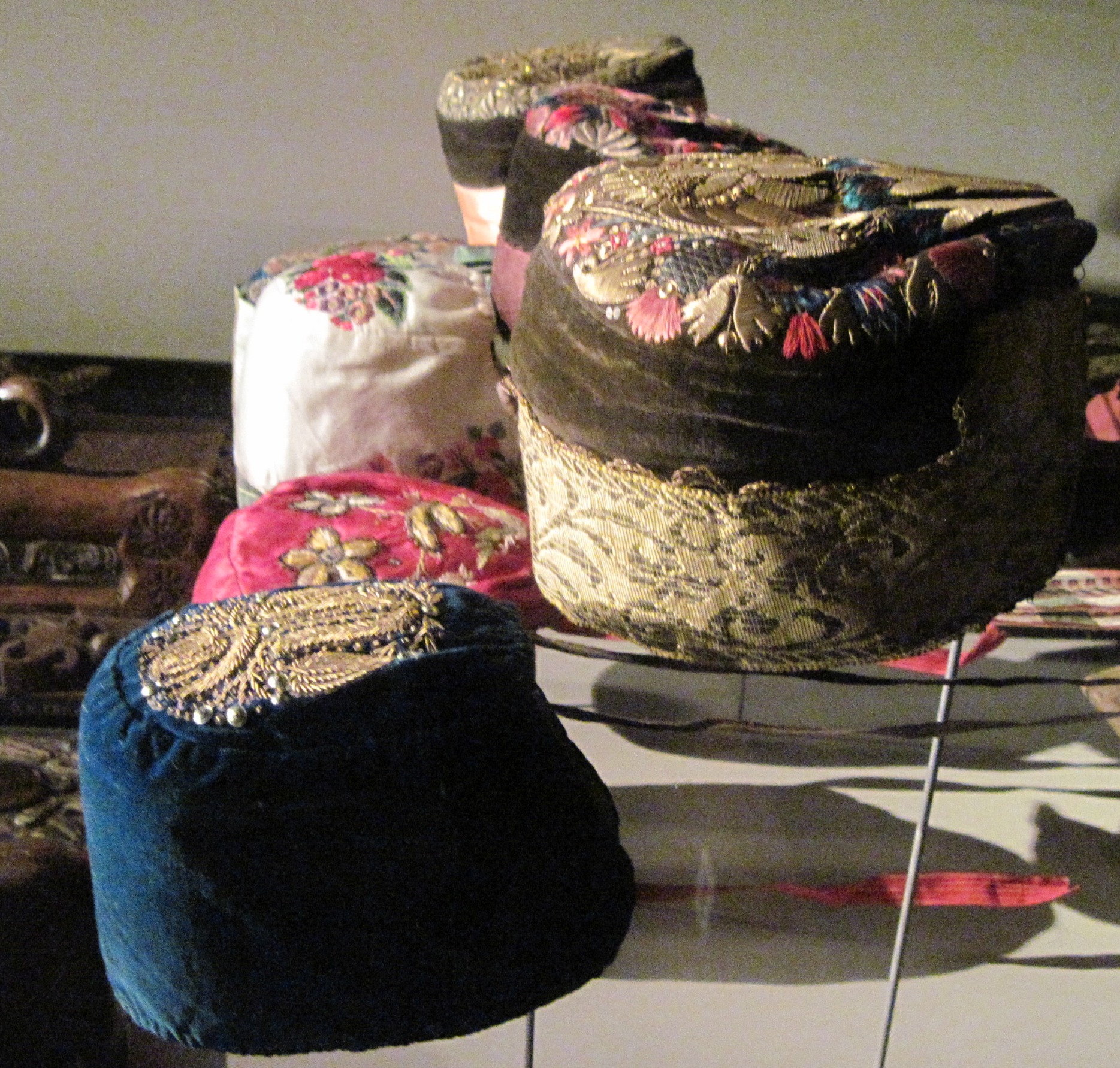
The Danish National Museum is a gigantic building presenting Danish history from the earliest days down to modern times, all beautifully displayed and with excellent information about the objects.

Peasant women's caps, c. 1800, Danish National Museum

There’s no way to take it all in but, after two+ hours, we had only scratched the surface and needed a little retail therapy break so we went to the Royal Copenhagen store, housed in a fabulous old building.  The visit was all about looking because the prices for everything from porcelain to a sandwich  are astronomic.

Here is a recipe for Caramelized Potatoes.  Danish winters are cold so people glom onto food that will stick to the ribs.

Caramelized potatoes in profusion

Brunede Kartoffler (Serves 4)

About 1 1/2 lbs. small white or yellow-fleshed potatoes (the smaller the better)

3 tablespoons butter

1 cup white sugar

To prepare:

Boil potatoes with skin on until tender. Let them cool enough to be able to peel without burning your fingers.

Put sugar in a frying pan. Put the butter on top of the sugar. Turn on low heat and stir as the sugar melts and begins to brown. When it is caramelized, add the potatoes, constantly turning them until the syrup sticks to them. (This takes 5-10 minutes.) Serve and don’t apologize for the calories.  These potatoes go well with any hearty entrée like duck, beef, pork—even chicken. A little aquavit helps wash it down, at least the Danes think so.

Posted in Uncategorized | Tagged , , , , | 9 Comments

Blue, Gray and Multi


Iceland’s Blue Lagoon

Blue

Is the color of the water in Iceland’s Blue Lagoon—baby blue, due to the silicone and algae in it. The Blue Lagoon is a huge attraction, both for Icelanders, (who jump into water, both cold and hot at every opportunity), and tourists. It’s  about twenty minutes from Reykjavik (and how proud am I to be able to spell that!) where  you check in,  pay and are issued a big, blue towel and a blue plastic bracelet with a computer chip on which everything is charged. To the lockers and then into showers where you’re advised to rub a ton of conditioner in your hair due to the high mineral content of the water.  Next comes a bracing walk outside (it was cold and rainy but people do it in all weathers including snow) and into the lagoon, full of hot, blue water. Silica mud from the bottom is available in boxes for applying to any part you like.

Someone (not me) applying silica mud.

At an in-water bar you can buy beer, ice cream and other items. Everyone is friendly and well-behaved. I had an in-water massage on a floating rubber mat covered by a blanket, tended by Eva, a lovely masseuse in a hat and a wet suit. She dunked me under every few minutes so I’d stay warm. It was a great massage and a fabulous experience from start to finish. Afterwards, my skin felt meltingly soft for days.

Gray

Is the color of the lava wall marking the site where the Icelandic Alpingi (Parliament) was established in 930. It’s inside Pingvellir National Park in the rift valley where the North American section of one tectonic plate is slowly separating from the Eurasian section. Earlier in the day, we’d stopped at Kerið, a volcanic crater lake in southern Iceland

Kerio crater lake, southern Iceland


and also went to the Faxa waterfall next to a salmon ladder so the fish are able to jump upstream to spawn. Also went to Geysir where there are two geysers, a big one, Strokkur, that erupts roughly every five minutes, and a smaller one that’s more like a boiling hole in the ground.   The geothermal heat that erupts as steam all over Iceland provides hot water for the whole country at no cost. How’s that for a terrific natural resource?

Salmon ladder next to Faxa waterfall

Strokker, the big geyser at Geysir

Rift Valley, Pingvillir (or Thingvillir) National Park


MultiColored

Describes one of the best meals I ever ate, this at Sjávarkjallarinn (Seafood Cellar). My entrée was poached ling, (a fish) over ‘pointed’ cabbage with crispy bread, spring onions, green beans and Icelandic herbs. )

Sauteed Langoustine appetizer

This picture is of my langoustine appetizer. If you’re already wailing over so much language, this was the description of dessert: birch ice cream, smoked marshmallow sitting in a puddle of vinegared caramel with torched meringue and sweet cheese pudding. Yes, it sounds bizarre but in the mouth it was amazing (and that was the dessert I’d ordered—it was preceded by an “amuse dessert,” if there is such a thing, a chef’s gift of an oval scoop of skyr ice cream (skyr is a bit like yogurt) with dried blueberries, something crumbly and dill. The entire meal was exquisite to eat, served in a beautiful setting.

No way on earth would or could I  replicate any of this so here’s an Icelandish recipe that ordinary mortals can handle.

Herring in Cream Sauce with Orange

16 oz herring in cream sauce (from a fancy food store or a jar)

½ navel orange, sliced very thin

½ small onion sliced thin (optional but good if you’re an onion fan.)

Few sprigs of fresh dill

Sliced black bread

Combine the herring with its sauce and the orange slices (squeeze a little more orange from the uncut slices) in a bowl and mix gently. Allow to sit, in the fridge, for four hours or a bit more. Remove and bring to room temperature. Put herring into an attractive bowl and garnish with the dill (on the side or chop finely and sprinkle over top of herring.) Serve with the darkest bread you can locate.

Skol, as they say in Iceland (pronounced “skowal”).

Posted in Uncategorized | Tagged , , , | 5 Comments

Tight Little Island

Flag of Iceland

No, not Britain. Iceland, a country with a total population of 318,000 people, two-thirds of whom live here in Reykjavik. The whole country is roughly the size of Kentucky. The people have tremendous self-esteem which must be part of the reason Iceland is slowly inching back from the huge financial “crash” of 2008.  Since the country has  a very high literacy rate thanks to excellent schooling; great health care; little crime, and a passion for life outdoors, Icelanders have a right to feel good about themselves.

Buildings are either state-of the art contemporary like Harpa,

the brand new art center designed by Olafur Eliasson, the Icelandic-Danish artist who made the waterfalls in the East River last summer; built of concrete, (useful in a place of extreme weather), or cutely old-world made of wood, sometimes with the addition of corrugated iron.

The puffin, a particularly appealing Arctic bird, appears all over the place.

Puffins


It’s served smoked  but, happily, hasn’t been on any menu I’ve seen because it would feel a little like eating Bambi. Meanwhile, smoked salmon is coming out of my ears along with Arctic char, scallops and Icelandic lobster which is more like a langoustine.  Our first night’s dinner was preceded by a very interesting cocktail called a “Birkir,” made of a birch liquor, ginger ale, vodka and a splash of lemon, garnished with a birch leaf and sprig of thyme. Unusual and delicious.

Birkir cocktail

Icelanders are charming, helpful and tough–they have to be as natural disasters, like volcanoes, happen all the time. We saw two documentaries at Volcano House and talked to a woman whose mother remembers the 1973 event that wiped out a large section of the “Western Islands.” Of course, they rebuilt in a very short period of time.  On the plus side sitting, as the country does, on an intersection of North American  and European Tectonic Plates, they have the Aurora Borealis, waterfalls, glaciers, geothermal pools and more.

At Volcano House, there’s a great poster showing how to make an Active Volcano Cake.

How to Make A Volcano Cake poster

Here’s what to do:

Take several sheets of heavy tinfoil and mold an upside down mountain. Fill it with chocolate cake batter (I plan to use a mix) and bake according to directions. When a knife comes out clean remove from the oven and let cool. Peel off the foil.

Invert your mountain and, with a sharp knife, cut off the top. Carefully scoop out some of the cake inside. Fill the cavity with the red jam of your choice. Put the top piece back on. Melt white chocolate and drizzle it over the top, sealing the hole and simulating snow. To serve, cut slices and watch the jam run out. Your volcano is erupting!

Santanka nu! (roughly ‘cheers’ in Icelandic, a language still directly related to what the Vikings spoke.)

Posted in Uncategorized | Tagged , , , , | 11 Comments

Is it Camping or Campy?

A much sleeker tent than the ones we had

Thirty-six years ago, four families, including nine children, went camping with actual, (albeit, rented), tents and sleeping bags. The tradition continues. Over the years, we’ve canoed Connecticut’s Housatonic and Vermont’s Battenkill; gone tubing on the Esopus River near Kingston, NY; hiked in Buck’s County, biked in East Hampton and walked through woods all over the place. After a few years, each family bought a tent (and man, what a pain to erect! Once, just after the tents were up, the Park Ranger arrived to make us move as we’d picked an area too close to the water. Much groaning ensued.)

As the four adult female campers were (still are) good cooks, a major feature has always been the meals, lugged in via Coleman coolers and other containers and originally cooked over a tiny Army stove and campfires. Alcohol has always flowed freely, sometimes starting with whiskey sours at breakfast (not for the kiddies.)

After two members of the group had surgery, we switched to spending the weekend at someone’s house. Once we wallowed in real beds and indoor plumbing, we never returned to the wilds but the tradition of great meals and lots of activities carries on.

This year’s “adventure” took place at a house on Lake Waramaug in Litchfield, CT.  The kids haven’t been with us for some time (having better things to do and kids

Lake Waramaug from the house

of their own to tend) but the adults are going strong. We  biked, hiked, watched the US Open and cried at the 9/11 ceremonies. Some of visited the  nearby Hollister House Garden,  a sort of recreation of an 18th century English-style garden with beautiful stonework and numerous garden “rooms.”


Sunday, everyone piled into a neighbor’s antique Buick station car (used to collect people arriving via the railroads back when US trains functioned) for a ride around the lake. The car has actual ‘isinglass curtains that can roll right down!”


1927 Buick Station Car


And, yes, the meals, still overabundant and terrific. Saturday’s breakfast consisted of every kind of fresh fruit imaginable; a frittata with grilled tomatoes, scallions, sausage mushrooms, red and yellow peppers and cheddar cheese; scones, ham and a fabulous coffee cake. Oh yes, and juices and coffee. Lunch was a choice of gazpacho or cucumber soup, cold, sliced meatloaf with Peter Lugar steak sauce or catsup,  sliced Challah and Asian coleslaw with cookies and watermelon to follow.

A little snack for Saturday lunch


My husband and I handled dinner: our grilled pork and peach dish; roast zucchini, summer squash and red onions and a rice salad with vegetables and fresh herbs followed by lemon cake, lemon sorbet and blueberries. We’ve finally gotten smart enough to not bring Sunday lunch and use the more- than- ample leftovers. The wonderful thing is that despite a few changes in the group mix due to the sturm-und- drang of life like  divorce/remarriage/death, almost all the original group remains in the mix. The kids refer to it as “meals surrounded by activities” which isn’t far off the mark. It’s always fun and I’m incredibly grateful that we’re still able to make it work and enjoy each others’  company.

Here’s the rice salad recipe, adapted from an edition of The Silver Palate:

Rice Salad

Be warned: this amount is gargantuan. You can easily decrease it by dividing, starting with the amount of rice.

Rice Salad, sort of from The Silver Palette

8 cups hot cooked long grain rice

2 cups “Our Favorite Vinaigrette” dressing

1 red pepper cut into slivers and slivers into 3 or 4 pieces each

1 green pepper cut same as red

6 scallions, green part only, cleaned and sliced fine

10 oz. frozen peas, lightly cooked so they aren’t mushy

1/2 cup Kalamata olives, pitted and chopped

1/ cup parsley, chopped

1/4 cup fresh dill, chopped

coarse salt and fresh ground pepper to taste.

Transfer hot rice to mixing bowl. Pour 1 1/2 cups of dressing over it and mix well. Cool to room temperature. When ready to serve, add everything else. Mix really well. Taste to see if more salt or pepper is needed, then serve.  (The rice tossed with dressing can be made the day ahead and combined with everything else and mixed again before serving.)

Favorite Vinaigrette (double this to make two cups)

1 T Dijon mustard

4 T red wine vinegar

1 tsp sugar

1/2 tsp salt

1/2 tsp fresh ground pepper

minced parsley  to taste

1/2 c olive oil

Put mustard in bowl. Whisk in vinegar, sugar, salt, pepper and herbs. Continue to whisk while adding oil slowly. Adjust seasoning. Cover until ready to use (I put it in a large jar and shook it up before using.)


Posted in Uncategorized | 6 Comments

Art, Engines and Schooners

Camden, Maine isn’t called the ‘Jewel of the Mid-Coast’ for nothing. The town, the picturesque harbor and the gracious old houses, many now converted to B&Bs or inns, are charming without overkill. There are numerous restaurants of every type and for every budget. And then there are the nearby museums.

In 1940, Andrew Wyeth married Betsy James in Maine. Through Betsy, he met Christina Olson, the model for his painting, Christina’s World, which hangs in New York’s Museum of Modern Art.  The Farnsworth Art Museum in Rockland, ME, has work by many artists but the big deal is their Wyeth collection, part of which hangs in an adjacent church that is now sort of a museum annex. The whole shebang is terrific. I found the Olson House in Cushing, ME,  where Christina and her brother, Alvarao, lived even more fascinating because it’s so personal.

Christina's World --the painting

In Wyeth’s painting, Christina lies towards the bottom of a large hillside looking towards her house. The picture omits the huge lilac bushes in the yard as well as Christina’s flower garden and the sense of scale is very different. In reality, the yard is next to the house, small and flat. (Christina had a never-really-diagnosed neuromuscular disease that, over time, left her unable to walk. A true Mainer, she mostly refused a wheelchair.)

Olson House--the real thing

Today, the house has been very carefully ‘brought back’; not restored in the traditional sense but the layers of grime on the walls have been removed and falling-apart floorboards replaced. Christina’s stove shines brightly which, according to the docent, it did not do when in use. Geraniums still sit in the windows as they do in one of the Wyeth paintings and the front door opens onto stencils of leaves on the floor, painted either by Betsy Wyeth herself or at her instigation, to  indicate leaves the wind would bring in.

Geraniums in Christina's Kitchen

Nearby is  the Owl’s Head Transportation Museum in—you guessed it—Owl’s Head, ME. It  displays old cars including a large MG collection;  aircraft like the Kitty Hawk Flyer and something called an ornithopter, technically an aircraft that moves by flapping its wings. This ornithopter has wings made of feathers, a tad too close to the Icarus thing for me. There are also old bicycles, fire engines, engines to make machinery function and a ‘gift shop’ where I passed on a aviator hat because it made me look too much like Snoopy minus the scarf.

Old Fire Engine, Owl's Head Transportation Museum

In addition to viewing, a lot of time was also given to sailing on Penobscot Bay in a schooner captained by the man who built her and eating–orange and lobster salad, cioppino, crab sandwiches, blueberry pancakes, stuffed lobster…

Making cioppino isn’t the work of a moment but it’s a great party dish if you want to go to the effort. Of course, you could order it in Maine (or at a good seafood restaurant anywhere–or in San Francisco where it may have originated.)

A Bowl of Cioppino

A (Relatively Easy) Cioppin0

1/4 cup olive oil

1 onion, chopped

3-4 cloves garlic, minced

1 green bell pepper, chopped

1 fresh red chile pepper, seeded and chopped

1/2 cup chopped fresh parsley

salt and pepper to taste

2 t dried basil

1 t dried oregano

1 t dried thyme

1 28 oz can crushed tomatoes

1 8 oz can tomato sauce

1/2 cup water

1 pinch paprika

1 pinch cayenne pepper

1 cup white wine

1 10 ounce can minced clams, drained with juice reserved

25 mussels, cleaned and debearded (meaning you scrub off all the black, hangy stuff)

25 shrimp

10 ounces scallops

1 pound cod fillets, cubed

In a large pot over medium heat, heat the olive oil, and saute the onion, garlic, bell pepper, and chile pepper until tender. Add parsley, salt and pepper, basil, oregano, thyme, tomatoes, tomato sauce, water, paprika, cayenne pepper, and juice from the clams. Stir well, reduce heat, and simmer 1 to 2 hours, adding wine a little at a time.

About 10 minutes before serving, add clams, mussels, shrimp, scallops, and cod. Turn the heat up slightly and stir. When the seafood is cooked through (the mussels will have opened, the shrimp turned pink, and the cod will be flaky), it’s ready to serve.  Pass crusty bread to sop it up with.


Posted in Uncategorized | Tagged , , , | 2 Comments

Happy as a Clam

The One and Only Cindy's

If anyone knows the derivation of this phrase, please let me know. It never made sense as clams seem like rather emotionless –albeit delicious—blobs. Good eating, yes but happy? Hard to tell.

One of the first things we did after arriving in Maine was to stop at Cindy’s, a roadside shack on Rt. 292/US1 just south of Freeport. Cindy’s has been in business for thirty-one years, is cash only and makes everything by hand including the tartar sauce. Our crab cakes were fantastic—loaded with crab meat, not filler. One man I talked with had driven miles just for lunch at Cindy’s.  Because our order somehow got semi-lost in the shuffle, Cindy (or one of her siblings) presented us with a large piece of Maine wild blueberry pie as we departed. (I realize this is a post about clams but …)

That evening, we went to the Waterfront Restaurant in Camden where I had a simple bowl of steamers (yes, clams) that brought back memories. When I was about four years old, my grandmother had a house in New Haven, CT right on the water. Eating clams began by collecting them. You tossed a pebble onto the wet sand, watched to see where bubbles emerged and then dug like mad to trap the clams. Afterwards, we steamed and ate them at a long picnic table on the beach. One day, I caught the biggest clam of all which was roundly applauded. The clam may not have been happy but I was.

Steamers

In case you thought I’d follow this theme with a clam recipe, think again. We are staying at the Whitehall Inn in Camden, a little charmer complete with a house dog, a Newfie-Lab mix, named Zeus; a room with eaves that (politely) scream old New England, and a mostly Serbian staff of delightful young women on a work/study program. At breakfast, our waiter, son of the previous owner, insisted on giving me the house granola recipe.  If you reduce the oats to 1 quart and then reduce all the other ingredients to six ounces each,  you will have a reasonable amount. Apparently it doesn’t freeze in the freezer but pours perfectly.

Granola

Whitehall Granola

5 quarts old fashioned oats

1 qt chopped walnuts

1 qt slivered almonds

1 qt wheat germ

1 qt shredded coconut

1 qt honey

1 qt safflower oil

Heat honey and oil together in a pan.  Then mix this with the oat mixture above. Heat the oven to 300º. Lay mixture on baking sheets and bake for 15 minutes. Stir and bake another 5 minutes. Cool and serve. Store in freezer to use as you wish.


Posted in Uncategorized | Tagged , , | 4 Comments

Pissaro, St. Bernards and Summer Pudding

Whenever I visit the Clark Art Institute in Williamstown, MA, I marvel that such incredible holdings came from sewing machines. Sterling Clark inherited a fortune from his grandfather who was a principal in the Singer sewing machine company. Initially, Sterling and his wife, Francine, collected Italian, Flemish and Dutch Old Masters  but later, their interests turned to “modern” artists including Sargent, Winslow Homer, Degas and others, ultimately amassing a large collection of Impressionists. They also gathered porcelain, silver and a lot of other goodies that caught their fancy.

The current show is Pissaro’s People, introduced by clothed figures of straw scattered about the lawns. The figures represent workers whom Pissaro admired— picking apples, gathering wheat, tending a cow. One figure looks a bit like Pissaro (long white beard) trundling a canvass to paint en plein air. Pissaro was a Sephardic Jew born in St. Thomas which was then a Danish colony. He kept his Danish nationality all his life. Besides being the backbone of the Impressionist group, Pissaro was a family man who had eight children he adored.

The Clark is a great place even though they have an odd policy of not allowing people to leave dogs in their cars. We went with friends who have a large St. Bernard (an oxymoron—ever seen a small one?) and because of the museum’s policy, took turns dog sitting and viewing the exhibit.

Dakota

That evening, (I don’t call this But I Digress for nothing), the same friends and others came for dinner. For dessert, I made a summer pudding that uses raspberries, blueberries, blackberries and strawberries. Among the recipe’s stellar features is that it’s best to make it the day before you serve it. Here’s the skinny:

Summer Pudding

Summer Pudding

1 c. raspberries

1 c. blackberries

1 c. blueberries

1 c/ strawberries   (full berry disclosure: you can easily substitute all frozen berries or frozen of any type you don’t have on hand in fresh form.)

1/4-1/2 c. sugar, depending on the sweetness of the berries (add 1/4 cup first and taste. Add a little more sugar if necessary.)

2 T Cassis

Grated zest of 1/2 lemon

8 slices white bread (You need spongy bread like Wonder or similar to make this work)

In saucepan combine berries (reserving a few for garnish), sugar,  lemon zest and Cassis. Bring to simmer. Cook until sugar has dissolved (about 4 minutes), stirring  occasionaly with wooden spoon, lightly crushing berries to release juices. Remove from heat and transfer to chilled bowl.

Line 3-cup bowl with plastic wrap, leaving a 2” overlap. Cut circle from one slice of bread to fit bottom of bowl  (I use the bottom of a drinking glass that’s the right size.)  Cut bread slices to line sides of bowl making sure there are no gaps. Press lightly into place.

Spoon berries and juice into bread-lined bowl, cover top with remaining slices cut to fit. Fold plastic wrap over bread and top with small flat plate that fits snugly into bowl. Place a weight on plate, refrigerate overnight.

When ready to serve, unfold plastic wrap from top of pudding and carefully invert bowl onto serving platter. Remove wrapping and garnish pudding with reserved berries.

Serve with creme fraiche or ice cream.


Posted in Uncategorized | Tagged , , , | 1 Comment